

Having romantic feelings for a close friend can bring hope, uncertainty and concern about the friendship. You may know each other well and still not know whether they want to date you. Friendship can be valuable in its own right; it does not create an obligation to return romantic feelings.
A useful next step is to decide what you want to say and give your friend room to choose. You can be honest without trying to create jealousy, withdraw care as a tactic or turn ordinary affection into a test.
On this page
Separate your feelings from their choice
You can feel attracted to someone without knowing what they feel. Sharing jokes, talking often, trusting you with personal matters or enjoying time together can all be part of friendship. They do not prove a wish for romance.
Ask yourself what you are hoping for: one date, an exclusive relationship or simply a clearer understanding of the connection. Also consider whether you can accept an answer you do not want. You do not need to feel perfectly confident, but it helps to approach the conversation with room for both people’s wishes.
Avoid keeping a mental account of the support you have offered. Being a good friend is not payment towards a future relationship. If listening to their dating experiences has become painful, you can set a limit because you need it, without using that limit to make them pursue you.
Decide whether and how to say something
You do not have to make a dramatic confession. A short, clear invitation may be easier to understand: “I’ve realised I’m interested in you romantically. Would you like to go on a date with me?” Make clear that you mean a date rather than hoping they will reinterpret an ordinary outing.
Choose a time when they can respond freely. Avoid asking in front of a group that may add pressure, during a crisis or when either of you is too intoxicated for a clear conversation. If work, housing or another dependency makes refusal difficult, take that context seriously before raising the subject.
Give them space to answer. You might say that they can take some time to think, then return to your own plans rather than repeatedly checking. You can also decide that you would rather keep your feelings private for now. Consider what would make that choice manageable for you.
Keep flirting and touch mutual
If you flirt, notice whether your friend welcomes the exchange. A joke in return may simply be a joke. Do not use sexual comments, surprise touching or increasing physical closeness to force a change in the relationship.
Ask before a new kind of physical affection, and stop if the response is uncertain or uncomfortable. Past closeness does not give permission for every future interaction. RAINN’s guide to consent explains that sexual consent involves clear, voluntary and ongoing agreement; flirting or earlier contact does not establish it.
Your friend’s comfort matters even if you feel embarrassed about asking. You can keep an invitation warm and straightforward without treating uncertainty as a challenge to overcome. They are allowed to want friendship, different forms of affection or less contact.
Respond respectfully to their answer
If they want to try a date, agree on a simple plan and keep talking as you discover what dating each other is like. Knowing someone as a friend does not settle questions about exclusivity, affection or the pace either of you wants.
If they say no, acknowledge the answer without arguing: “Thank you for being clear. I respect that.” You may need time to feel disappointed. Repeated requests, gifts intended to change their mind or asking mutual friends to persuade them can put pressure on the friendship.
If they are unsure, there is no agreement to date yet. You can give them space and decide how long you want to remain in uncertainty. A personal limit might be: “I understand you’re unsure. I’m going to treat this as friendship and make my own plans.” It does not need to become a deadline for them to choose you.
Consider what friendship can look like next
You may both want to continue the friendship, or one of you may need more distance. Be honest about what you can offer. A temporary pause from one-to-one plans can be a way to look after yourself, provided it is not presented as punishment for their answer.
Keep mutual friends out of a campaign to take sides. Respect private information and avoid monitoring who your friend dates. Make room for other relationships, interests and sources of support so that this one answer does not become the measure of your worth.
No conversation can guarantee that the friendship will stay exactly the same. What you can bring is clarity, respect and care for your own needs. The aim is a connection that both people can choose, whether that becomes dating, friendship or more distance.
Read the infographic in text
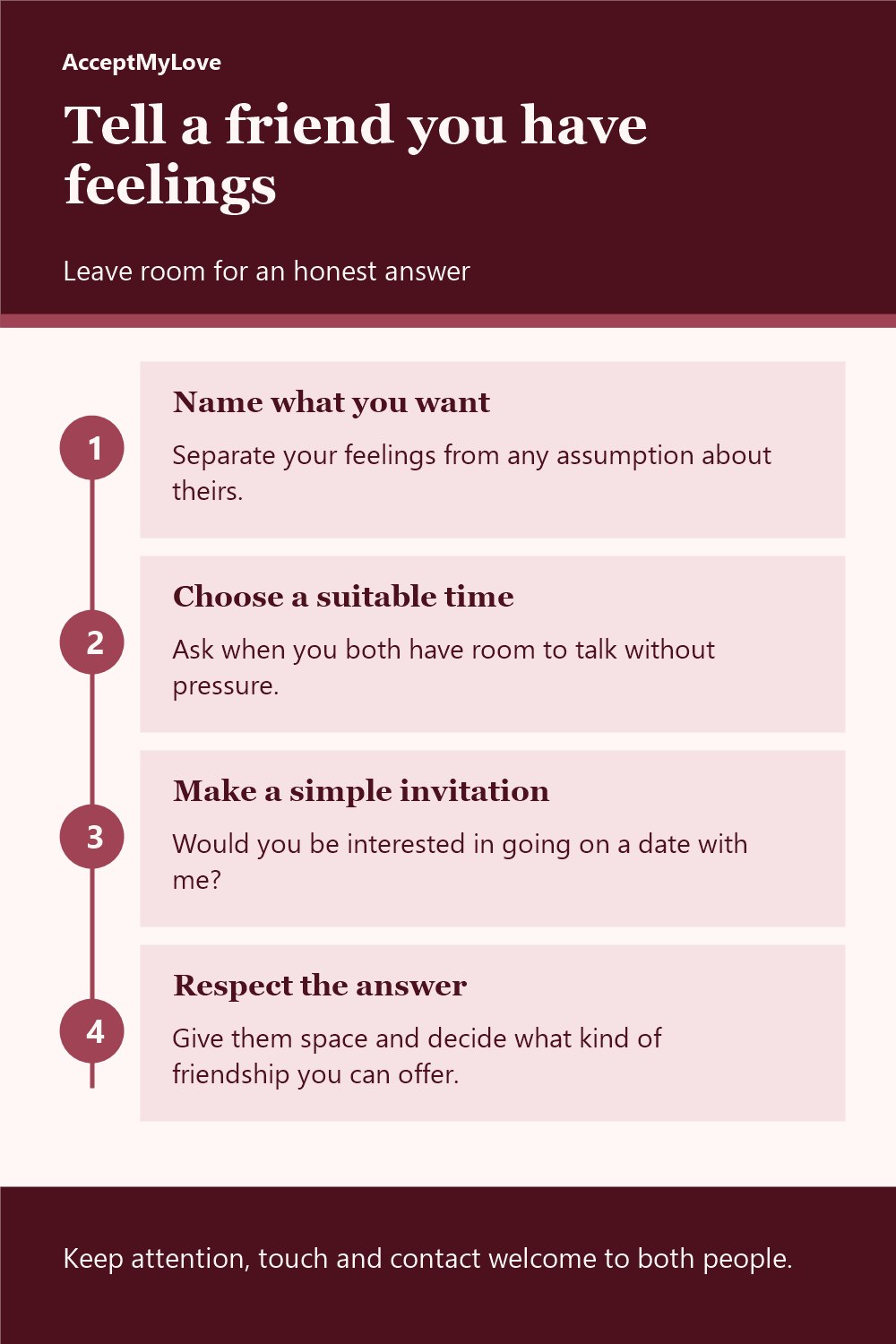
Tell a friend you have feelings
- Name what you want Separate your feelings from any assumption about theirs.
- Choose a suitable time Ask when you both have room to talk without pressure.
- Make a simple invitation Would you be interested in going on a date with me?
- Respect the answer Give them space and decide what kind of friendship you can offer.
Keep attention, touch and contact welcome to both people.