

Liking someone can make a simple message feel risky. You may worry that approaching him first, replying promptly or saying you would like a date will make you seem “desperate”. Showing interest is an ordinary part of dating. What matters is whether you respect his choices and your own needs.
You cannot make a particular person feel attracted to you. You can give them a fair chance to know you, ask for what you want and notice whether the connection is mutual. You do not need to manufacture jealousy, perform indifference or change how you dress to deserve respect.

Make room for interest without judging yourself
You are allowed to enjoy someone’s company and want another conversation. An invitation does not make you less independent, and asking for reassurance does not automatically make you demanding. Try describing what is happening specifically: “I want to know whether he would like a date” is easier to act on than “I must not look too keen”.
Confidence can include nervousness. You do not have to hide every sign that you care. Equally, you can take time before sharing private information or becoming physically intimate. Choose a pace that feels comfortable rather than using closeness as a reward or withholding it to provoke pursuit.
Start a conversation and make a clear invitation
If the situation welcomes conversation, you can approach first. Mention a shared interest, ask a question and offer something about yourself. Someone who is working, rushing away or trying to end the exchange needs room to do that. Politeness on its own does not establish romantic interest.
When you want a date, you might say: “I’ve enjoyed talking with you. Would you like to get coffee with me as a date?” Suggest something realistic for your budget and availability. A direct question gives both people more information than waiting for the other person to pass a hidden test.
Keep your plans because they matter to you
Continue seeing friends, resting and making time for your interests. You do not need to be constantly busy or pretend that you are unavailable. If you want to meet and have time, it is fine to say yes. If an invitation conflicts with your plans, offer another time if you would like to.
Reply when you reasonably can. Delaying every message for a calculated number of hours can turn a conversation into a performance. You can also explain your preferences: “I’m usually away from my phone at work; an evening message suits me better.” Ask about theirs without promising constant access to yours.
Look for mutual effort over time
Notice whether you both initiate, ask questions, suggest plans and follow through. Effort will not look identical every day. Work, health, caring responsibilities and communication preferences can affect what each person can offer. Talk about a pattern that leaves you uncertain instead of turning each reply into a score.
If you repeatedly do all the planning, try a specific request: “I’d like you to choose our next date. Would you want to organise something?” Their response and subsequent actions can help you decide whether this connection works for you. You do not have to keep investing indefinitely while waiting to become more desirable.
State boundaries without using them as tactics
Clothing, makeup and enthusiasm do not determine whether someone deserves considerate treatment. You can enjoy flirting and still decline touch, sex, spending or a plan. A person’s disappointment does not create an obligation for you. Respect their limits just as clearly.
The love is respect guide to boundaries describes limits as a way to honour your needs and values. A boundary is about what you are comfortable doing; it is not a method of controlling who someone sees or making them prove their attraction.
Accept an answer and choose your next step
A clear no ends the invitation. If a message receives no response, repeated persuasion or contacting the person through friends and other accounts will not make the invitation more mutual. When an answer is vague, you can leave the next move with them and return to your own plans.
You may feel disappointed, and you can give yourself time. Someone declining a date does not settle your attractiveness or your future. The useful question is whether this particular connection offers interest, care and room for both people to choose freely.
Read the infographic in text
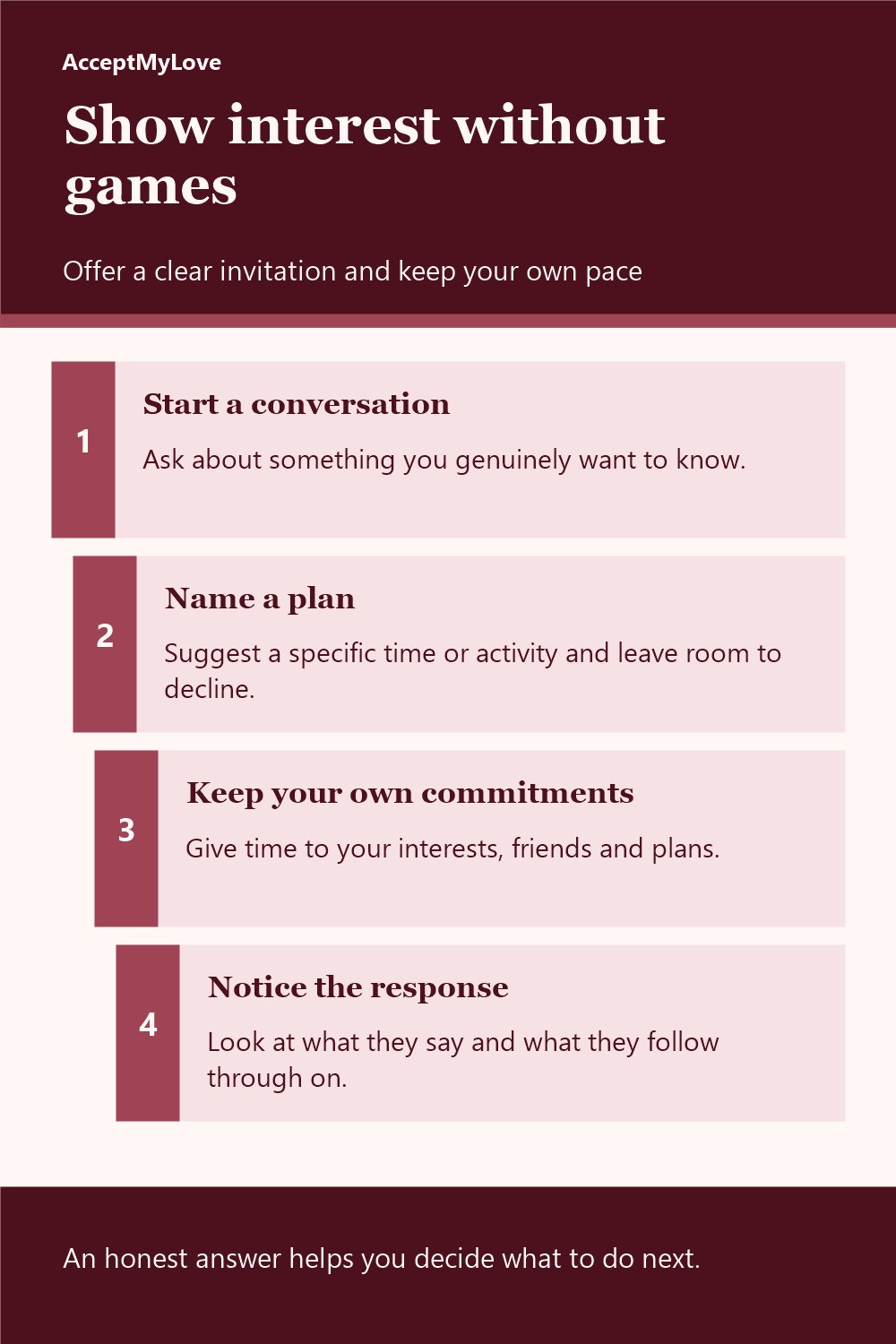
Show interest without games
- Start a conversation Ask about something you genuinely want to know.
- Name a plan Suggest a specific time or activity and leave room to decline.
- Keep your own commitments Give time to your interests, friends and plans.
- Notice the response Look at what they say and what they follow through on.
An honest answer helps you decide what to do next.