

Pocketing describes a relationship that one partner keeps hidden from important people in their life. It can feel confusing to be close in private but excluded from ordinary plans or introduced in a way that contradicts your agreement.
One missed introduction does not explain someone’s motives. Look at what you have agreed, how honestly it is discussed and whether the arrangement leaves room for both people’s needs.
Privacy and secrecy can mean different things
Some people rarely post about their personal lives. Others want time before introducing a partner to children, relatives or friends. Cultural pressures, family conflict and concerns about being outed can also make visibility complicated.
Those circumstances deserve respect. They do not remove your right to ask how the arrangement affects you. Neither partner should pressure the other to disclose their sexuality, identity or personal history before it is safe.
Compare the understanding you share. “We’re keeping our relationship off social media, and we both want that” differs from repeatedly denying an agreed relationship or demanding that you lie about it. The question is whether the arrangement is honest, freely accepted and workable for both of you.
Look at the pattern, not just social media
- Have you agreed that you are dating, and does their behaviour match that agreement?
- Can you make ordinary plans together, or must every meeting happen on their terms?
- Do you understand what is private, with whom and why?
- Can you ask about the arrangement without being mocked, blamed or threatened?
- Are you both willing to discuss how your needs might change?
Separate an observation from a guess. “You introduced me as a friend after we agreed we were partners” is something you can discuss. “You must be ashamed of me” assumes a motive you may not know.
A private person can be considerate and consistent. Concern grows when secrecy comes with dishonesty, broken agreements or pressure to accept something you have said is hurting you.

Start with a specific conversation
Choose a calm moment when it feels safe to talk. Describe one event, its effect on you and the question you need answered. For example: “When we saw your friends, you introduced me as a friend. I felt uncertain about where I stand. How do you understand our relationship?”
Listen to the explanation without treating it as the end of the discussion. Ask what privacy means in practice: “Who knows we’re together?” “What would you want me to say if someone asks?” “Which introductions would feel comfortable, if any?”
Explain your own needs too. You might be comfortable staying off social media while wanting to meet a trusted friend. Someone else may need a relationship that can be acknowledged more openly. Neither need makes forcing disclosure acceptable.
Decide what you can accept
You do not have to prove deliberate deception before deciding that an arrangement does not meet your needs. A boundary describes what you will choose; it does not require the other person to abandon their privacy.
For example: “I won’t post about us without your permission. I also don’t want a continuing relationship in which I must deny we are together. If that is the only arrangement available, I need to step back.”
If the conversation is also about time apart, read When Your Partner Needs Space: Clear Agreements and Your Needs. Privacy, space and commitment are related questions, but they are not interchangeable.
Agree on one realistic next step
If you both want to continue, make the agreement specific. Perhaps you will check before tagging photographs, discuss how to handle a chance meeting or decide together whether an introduction is appropriate. Choose a time to revisit the arrangement that works for both of you.
A review date is an opportunity to talk, not a deadline for coming out, introducing children or making an unsafe disclosure. Notice what actually happens afterwards. Repeatedly changing the explanation or disregarding a shared agreement deserves attention.
Love is respect’s digital-boundaries guide can help you discuss photographs, tags, messages and account privacy. Giving up a password is not a substitute for trust.
Choose support rather than a test
Searching a partner’s accounts, turning up unexpectedly or posting the relationship to force a response can violate privacy and escalate conflict. Ask directly where you can; if it is unsafe to ask, seek independent support rather than setting up a confrontation.
Talking with someone you trust may help you sort what you know from what you fear. You can also read When Relationship Effort Feels Uneven: Needs, Capacity and Change when the issue extends beyond introductions.
Your next step may be a clearer agreement, more time to consider your needs or leaving the relationship. Base that choice on the arrangement available to you, without needing certainty about someone else’s private feelings.
Read the infographic in text
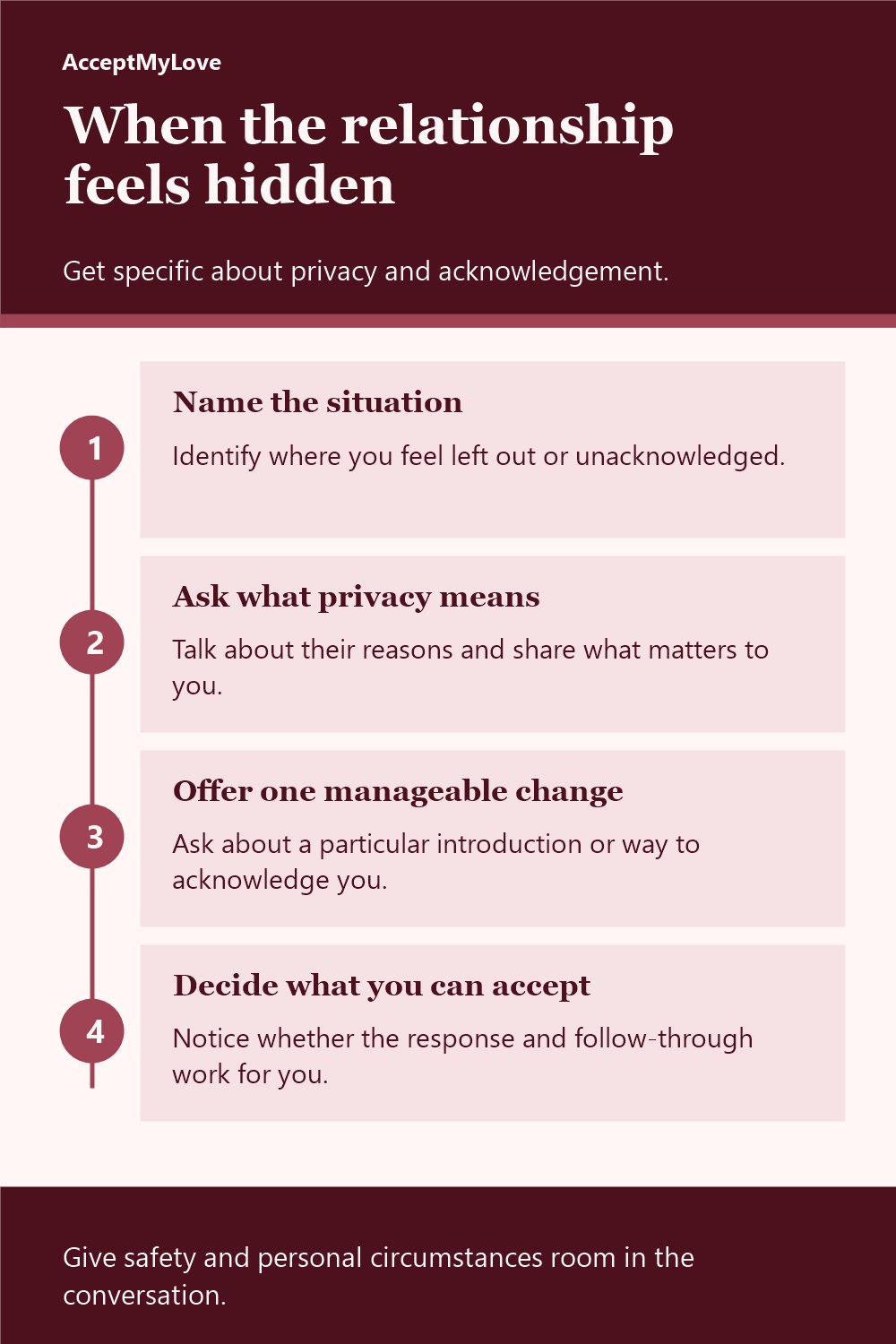
When the relationship feels hidden Get specific about privacy and acknowledgement.
- Name the situation Identify where you feel left out or unacknowledged.
- Ask what privacy means Talk about their reasons and share what matters to you.
- Offer one manageable change Ask about a particular introduction or way to acknowledge you.
- Decide what you can accept Notice whether the response and follow-through work for you.
Give safety and personal circumstances room in the conversation.