

Is it better to love someone more, or to be the person who is loved more? The question can feel urgent when you are choosing a partner or wondering why your feelings do not seem evenly matched. Yet love has no reliable scoreboard. Being pursued more intensely does not by itself make a relationship secure or satisfying.
A more useful question is whether you both freely want this relationship and treat each other with care. Different expressions of affection can coexist with mutual commitment. Persistent indifference, pressure or unmet needs deserve attention even when one person says they love the other deeply.
Separate different expressions from a lack of interest
One person may use affectionate words often; another may show care through practical help or shared time. Neither style proves the size of someone’s feelings. Ask what each gesture means rather than assuming that quietness, expensive gifts or frequent messages tell the whole story.
Differences still matter when they leave a need unmet. You may appreciate practical support and also want verbal affection. Your partner may enjoy closeness and need more time alone. You can discuss both without declaring that one of you is the loving person and the other is merely receiving.
Look for care you can describe
Consider ordinary situations: do you listen to each other, take a no seriously, follow through on agreements and make room for each other’s interests? Can you raise a concern without being mocked or made to feel guilty? These questions give you something concrete to discuss.
Support may be uneven during illness, bereavement or a demanding period. Mutuality does not require equal effort every hour. It does involve recognising the strain, discussing what is possible and caring about the person who is providing more support. A difficult season is different from a pattern in which your needs are always dismissed.
Talk about what you want rather than testing devotion
Choose a specific concern and a time when you can talk without rushing. You might say: “I enjoy our time together, but I’m unsure whether we want the same kind of relationship. What are you hoping for?” Then listen to the answer, including uncertainty you would rather not hear.
For everyday affection, a practical request can help: “Could we have one evening together without work messages?” The NHS guidance on healthy relationships encourages open conversations, listening and regular check-ins. Agree on something you both want to try; creating jealousy or disappearing to see who chases you adds uncertainty.
Consider compatibility alongside affection
Strong feelings do not resolve every difference about children, exclusivity, location, money or daily life. If you are considering marriage or another commitment, discuss the practical decisions involved. You do not have to assume that passion will solve them, or that companionship requires giving up affection.
Your preferences can change with experience, and you do not have to recreate your first relationship. Notice what belongs to the person in front of you and what you are expecting because of the past. Familiar chemistry can be appealing, but it is not enough information about how you would live together.
Leave room for an honest no
Someone loving you does not mean that you owe them romance, marriage, sex or continued dating. Gratitude and affection can exist without the wish for a relationship. If your feelings are not developing, be honest about what you can offer rather than promising a future to avoid hurting them today.
The same freedom applies when you love someone who does not want to continue. You can express disappointment and ask practical questions, while accepting their decision. Neither person has to prove that they tried hard enough to earn the right to leave.
Make a decision based on the relationship you have
If you both want to continue, choose a concrete next step and a time to revisit it: sharing the planning, making more time together or discussing an unresolved difference. Look at what actually changes rather than repeatedly measuring declarations of love. Support from a qualified counsellor may be useful when you both want help and feel safe speaking freely.
You can also decide that the relationship does not meet your needs. Intensity, gratitude or fear of being alone need not decide for you. Aim for a connection in which you can give care, receive it and remain a person with choices of your own.
Read the infographic in text
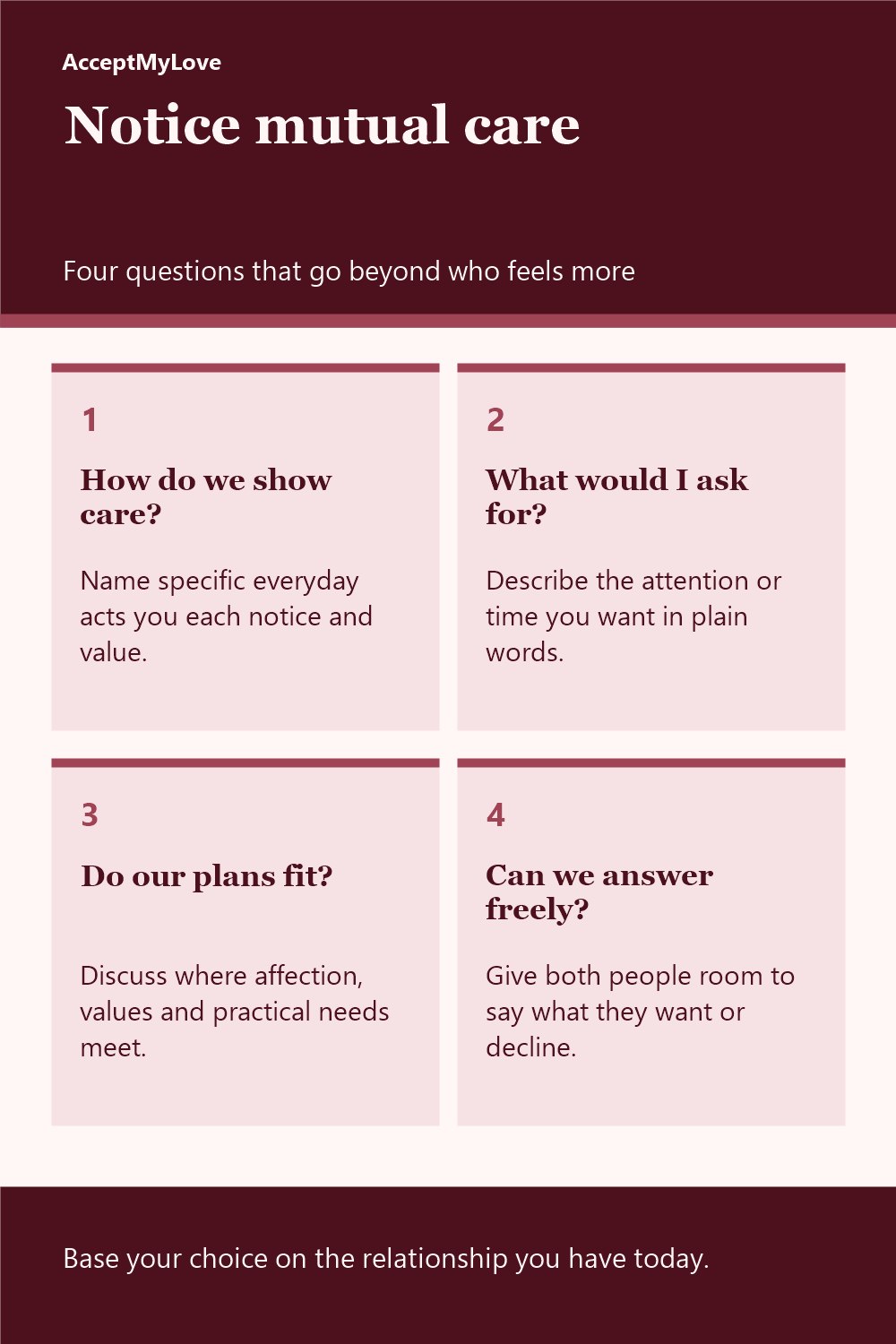
Notice mutual care
- How do we show care? Name specific everyday acts you each notice and value.
- What would I ask for? Describe the attention or time you want in plain words.
- Do our plans fit? Discuss where affection, values and practical needs meet.
- Can we answer freely? Give both people room to say what they want or decline.
Base your choice on the relationship you have today.