

Having romantic feelings for a friend who does not want to date you can bring two kinds of uncertainty: disappointment about the romance you hoped for, and worry about what happens to the friendship. You do not have to deny either feeling or decide immediately whether you can stay close.
A friend’s lack of romantic interest does not make your feelings shameful. It also does not create an obligation for them to try a relationship. The aim is to care for yourself while respecting what they have told you, rather than treating continued friendship as a way to earn a different answer.
Make room for disappointment without bargaining
You may be grieving a possibility rather than a relationship you actually had. Sadness, anger or embarrassment can still feel real. Give yourself room to feel them without using your friend as the only person who helps you process the rejection. A trusted person outside the situation may be easier to talk with.
I have been through this with Shea and with other friends. Sadness and frustration sometimes returned after I thought I had moved past them. That could make me feel foolish, but a returning feeling did not mean that I had to act on it or ask for a different answer.
There is no hormone level or fixed number of months that can tell you how long your own feelings will last. Focus on what is making daily life more manageable rather than comparing yourself with a supposed timetable.
Choose distance that gives you room to recover
Distance can mean fewer private messages, a break from one-to-one meetings or spending more time with other friends. It does not have to follow a universal rule about calls per week. Choose an arrangement you can sustain and explain it simply if that feels appropriate: “I value our friendship, and I need a little time to settle my feelings.”
Notice favours or emotional support you are giving with an unspoken hope of romance. You can reduce what leaves you resentful without presenting your friend with a bill for past kindness. Keep mutual responsibilities clear, and do not use distance as a threat or a test of whether they will chase you.
Choose media that leaves you feeling steadier
Romantic stories and songs can be comforting, but they can also keep you rehearsing the same wish. When I was having a difficult time, I usually stepped away from romantic media because it made me feel as though I was failing at something essential. I paid attention to whether particular songs left me feeling better or lower.
You can experiment without banning an entire genre. Try a comedy, a practical project or a story about friendship, work or adventure. Romance does not have to occupy every part of your attention, and taking a break from it does not mean you have become cynical.
Imagine your feelings as a visitor, if the metaphor helps
One way to make a little room around a feeling is to imagine it as a third person joining the friendship. The visitor may be intense, hopeful and determined to redirect every conversation toward romance. This is a metaphor for noticing your thoughts, not a separate person you must fight or a test you need to pass.
You can acknowledge the visitor: “There is that hope again.” Then decide what you want to do with your attention. You do not have to argue the feeling out of existence before listening to your friend or choosing to leave a conversation that feels too difficult.
Notice when the romantic hope arrives
I could be having coffee with a friend I had a crush on, talking about our lives and enjoying the friendship, when they would say something that reminded me how much I liked them. Suddenly I would be thinking about how wonderful it would be if they felt the same way. That was the moment I imagined “Mr Feelings” arriving.
Treating the feeling as a visitor helped me recognise what was happening. I could acknowledge it while remembering that the person in front of me also mattered. The metaphor did not guarantee that the feeling would disappear; it gave me a way to notice it before allowing it to take over the conversation.
If a metaphor feels awkward or makes things worse, leave it aside. You might prefer to name the feeling plainly, take a short break or change the kind of contact you have for a while.
Give your energy another place to go
After my worst heartbreak, I decided that I wanted to become a lawyer. I spent much of my free time studying and practising for the LSAT, aiming for a score that could get me into a top institution. I later realised that what I wanted was to feel tough and independent, which was different from wanting a legal career.
Fortunately, I recognised that before going to law school. I had strong LSAT scores to show for the study, and the experience boosted my self-esteem. The lesson was not that heartbreak should decide a career; it was that an ambitious plan could help me discover what I actually wanted.
While getting over Shea, I also made a hat. I spun the yarn myself and knitted it while thinking about the qualities I loved in him, as well as the sadness I felt. Over time, I could set those thoughts aside and put attention into other parts of my life.
Making something gave my feelings somewhere to go without asking Shea to change his. You might prefer writing, music, learning a skill or a manageable activity with other people. You do not have to turn pain into an impressive achievement for the activity to be worthwhile.

Revisit the friendship based on how it feels now
My feelings eventually changed. I could communicate with Shea without the same mixed feelings, and I appreciated what those experiences had taught me about boundaries and treating myself kindly. Some friendships deepened through that process. That was my experience, not a promise about how every friendship will develop.
Ask whether the friendship you have now feels workable. Can you respect their dating choices without constantly hoping they will reconsider? Can you say no to contact you are not ready for? Staying friends, taking more space or ending the friendship can each be a choice you make with care.
The NHS guidance on healthy relationships includes time for your own interests, boundaries and support from someone you trust. If the distress is making daily life difficult, consider speaking with a qualified health professional or counsellor. You do not have to manage it entirely alone.
Read the infographic in text
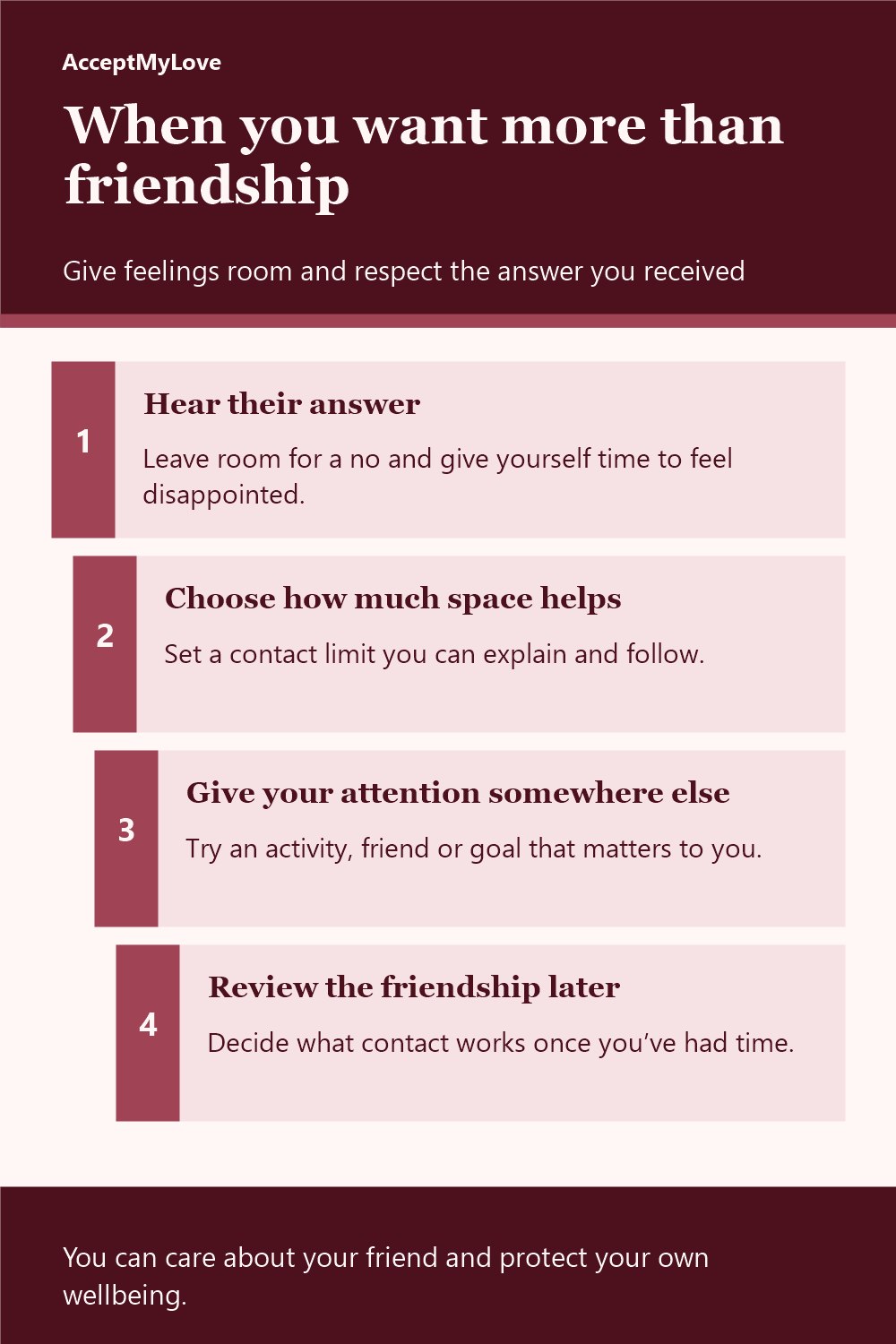
When you want more than friendship
- Hear their answer Leave room for a no and give yourself time to feel disappointed.
- Choose how much space helps Set a contact limit you can explain and follow.
- Give your attention somewhere else Try an activity, friend or goal that matters to you.
- Review the friendship later Decide what contact works once you’ve had time.
You can care about your friend and protect your own wellbeing.