

When life feels heavy, the idea of clearing or renewing your soul may express a wish for rest, meaning or a fresh start. You may find that language helpful within your faith or personal spirituality. Begin by asking what you hope will feel different in everyday life.
Renewal might mean making time for prayer, reflecting on a conflict, reconnecting with a community or doing something you have been postponing. You do not have to treat yourself as broken or impure to make a change. Choose practices that support your life and leave you free to question, pause or seek other help.
Name what you want to renew
Try turning a broad wish such as “I need to clear my energy” into something you can describe. Are you exhausted, preoccupied by an argument, missing a sense of purpose or carrying guilt about something you did? You may understand the experience spiritually and still identify the practical need beneath it.
Choose a modest intention: “I want a quieter evening”, “I want to apologise without making excuses” or “I want to reconnect with a practice that matters to me”. A clear intention gives you something to return to without requiring a dramatic experience or an immediate change of mood.
Keep spiritual teachings connected to their traditions
Shekhinah is a term from Jewish teaching. In Tzvi Freeman’s explanation on Chabad.org, Shekhinah refers to the divine presence; feminine language describes that presence rather than a separate female deity. His account discusses soul, repair and divine sparks within a particular mystical teaching.
If that teaching interests you, read it in context or speak with a knowledgeable teacher in the tradition. Ideas about divine presence, reincarnation and karma should not be treated as interchangeable explanations. People within and between traditions may understand spiritual renewal differently, and you can acknowledge those differences without dismissing someone else’s faith.
Make a quiet practice simple and optional
Set aside a few minutes in a place where you feel reasonably comfortable. You might read a short passage, pray in your own tradition, write in a journal or sit quietly and notice the room around you. Use ordinary breathing; you do not need to force a special state or complete an elaborate ritual.
A simple journal prompt is: “What am I carrying, what matters to me, and what is one kind action I can take?” You can stop after one sentence. If a practice leaves you more distressed or does not suit you, pause and choose something else. A short walk or a conversation may be more helpful that day.

Let difficult feelings exist without calling them contamination
Anger, sadness, jealousy or doubt can be uncomfortable without making your soul dirty. You can notice a feeling and consider what it is pointing toward: hurt, a crossed boundary, a disappointment or a need for rest. You do not have to suppress it to prove that you are spiritually advanced.
Treat sleep as an opportunity for rest rather than a test of whether your soul has completed a task. Beliefs about what happens to the soul during sleep can carry religious meaning, but you do not need to interpret an unsettled night as evidence that you have failed or been punished.
Connect reflection with practical repair
If you harmed someone, consider what responsibility belongs to you and what action could help: a specific apology, returning something, correcting misinformation or changing a repeated behaviour. A private ritual does not require another person to forgive you, and they remain free to set limits.
If someone harmed you, renewal need not mean re-establishing contact. You can keep a boundary, seek support and decide what would make your situation more workable. Reflection can help you identify a next step; it does not require you to carry responsibility for another person’s actions.
Notice what a practice adds to your life
After trying a practice, ask whether it leaves more room for your values, responsibilities and relationships. Are you resting, making choices and treating yourself and others with care? You do not need to measure success by visions, signs or a constant sense of peace.
Keep the cost and time within limits you choose. You can decline anyone who insists that fear, urgent spending or repeated paid rituals are necessary to make you safe. A trusted community member or spiritual leader may offer perspective; if distress is affecting daily life, support from a qualified health professional can sit alongside your spiritual practice.
A useful next step can be small: close the journal, contact someone you trust or make one practical repair. Renewal can be an ongoing way of living rather than a state you must finally achieve.
A short reflection before a difficult apology
Imagine you’ve been rushing between work and family commitments and keep answering sharply at home. Take a quiet moment with a practice that is familiar and meaningful to you. Ask what needs repair and what would make a better response possible next time.
You could apologise for the specific words and ask for fifteen quiet minutes when you first come home. Later in the week, notice whether the changed routine and the apology helped the conversations you were concerned about.
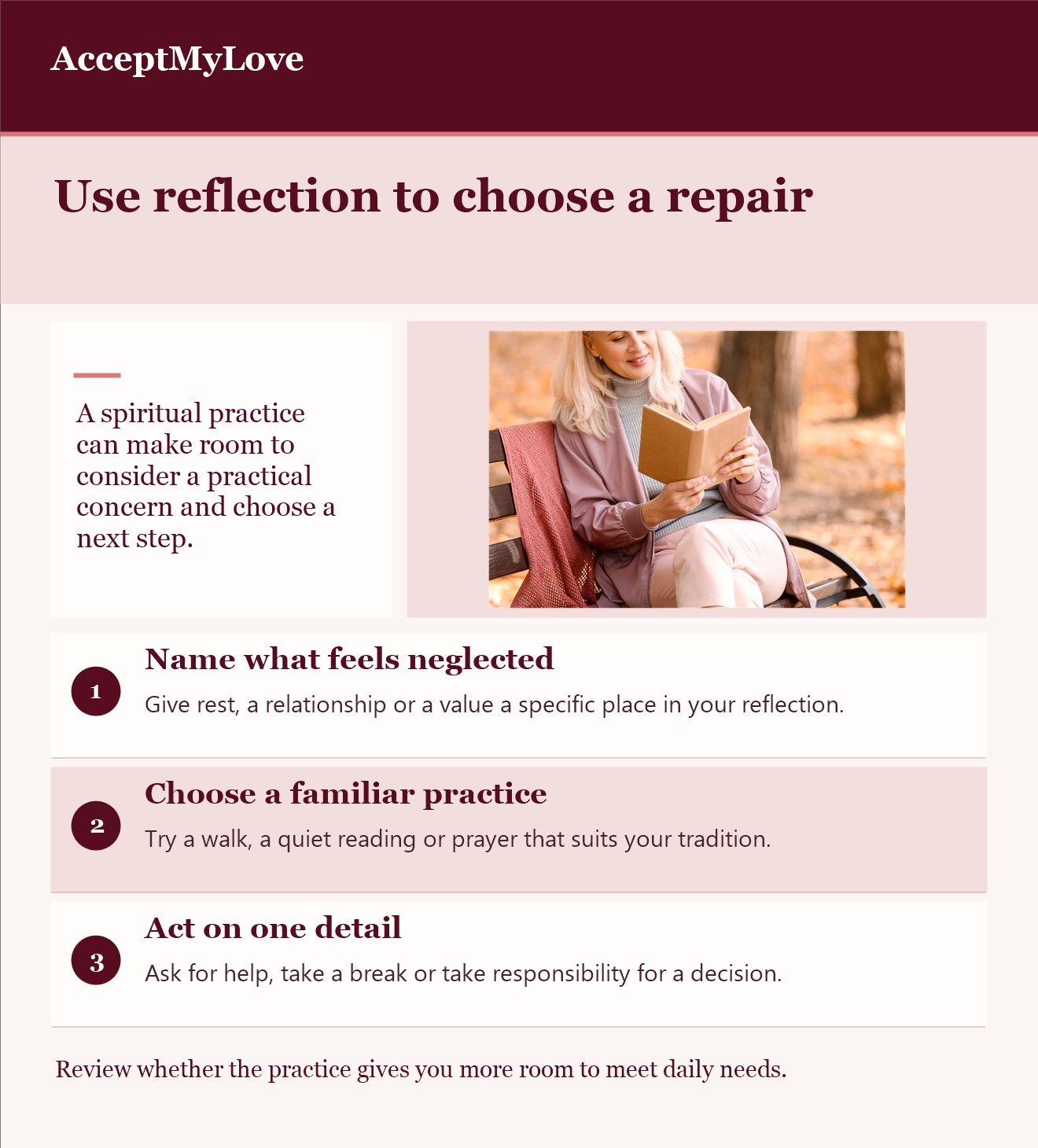
Read the infographic in text
Use reflection to choose a repair
A spiritual practice can make room to consider a practical concern and choose a next step.
- Name what feels neglected Give rest, a relationship or a value a specific place in your reflection.
- Choose a familiar practice Try a walk, a quiet reading or prayer that suits your tradition.
- Act on one detail Ask for help, take a break or take responsibility for a decision.
Review whether the practice gives you more room to meet daily needs.