

Strong chemistry can make a new connection feel certain before you know much about the person. You might wonder whether you are in love, experiencing sexual desire or feeling both. You do not have to find a perfect label immediately, but you can take time to understand what you want and how you treat each other.
Love and lust are not opposite moral categories. Sexual attraction is not automatically shallow, and caring deeply does not create an obligation to have sex. Instead of using intensity as proof, consider the relationship you are building and whether its expectations work for both of you.
Separate attraction, affection and commitment
Sexual attraction concerns a wish for sexual closeness with someone. Romantic attraction can involve wanting a romantic bond, while affection and care can also exist in friendships and other relationships. Commitment is an agreement about what you will do together. These experiences may overlap without always appearing in the same combination.
The Asexual Visibility and Education Network’s relationship FAQ explains that romantic and sexual attraction can be experienced separately. A person may love a partner without experiencing sexual attraction. Ask about the individual’s experience rather than using a lack of desire as evidence that they cannot care.
Notice what interests you beyond the chemistry
Are you curious about the person’s ideas, preferences and ordinary life? Do you enjoy time together that does not involve flirting or sex? You can appreciate physical attraction while also learning whether you like the person you are getting to know.
There is no need to dismiss a connection because attraction arrived quickly. Equally, strong desire does not tell you whether you share goals, handle disagreements well or feel comfortable being honest. Leave room for information that complicates your first impression.

Look at everyday care and respect
Notice how each of you responds to a change of plan, a disagreement or a boundary. Can you listen without turning every concern into a contest? Do you follow through on agreements and take responsibility when something goes wrong? These patterns offer more useful information than a declaration made during an intense moment.
Care does not require constant availability or self-sacrifice. You can value time together and maintain friendships, privacy and rest. If affection only seems available when you agree to something you do not want, pause and consider whether the connection gives you room to choose.
Talk about expectations before assuming they match
One person may want a casual connection while another hopes for a committed partnership. Neither should have to infer the agreement from chemistry alone. You might ask: “What are you looking for at the moment?” or “Are we agreeing to exclusivity, or are we still getting to know each other?”
Listen to what the person offers now. A vague possibility of a future relationship is different from a shared decision to build one. You can enjoy someone and still decide that the arrangement does not meet your needs. For a closer look at different expressions of care, explore choosing mutual care rather than keeping score.
Keep consent separate from proving love
You do not owe sexual activity because you flirted, accepted a date, had sex before or said “I love you”. The other person has the same freedom. Ask about what each of you wants, respect a no or a change of mind, and avoid treating hesitation as something to overcome.
The love is respect guide to consent describes consent as an ongoing mutual agreement. Feeling loved is not a substitute for checking what is welcome. You can discuss different needs without turning sex into a debt, a reward or a test of devotion.
Give the connection time without expecting a guarantee
There is no fixed point at which desire becomes love, and no single feeling can diagnose the state of a relationship. Attraction may change; affection may deepen, remain uncertain or fade. Time creates opportunities to learn, but patience alone does not guarantee compatibility.
Choose the next step that fits what you know: another date, a conversation about expectations, a slower pace or an end to the connection. You can ask yourself whether you feel respected, can speak honestly and want the relationship that is actually available. You do not need to decide the rest of your life from the strength of today’s chemistry.
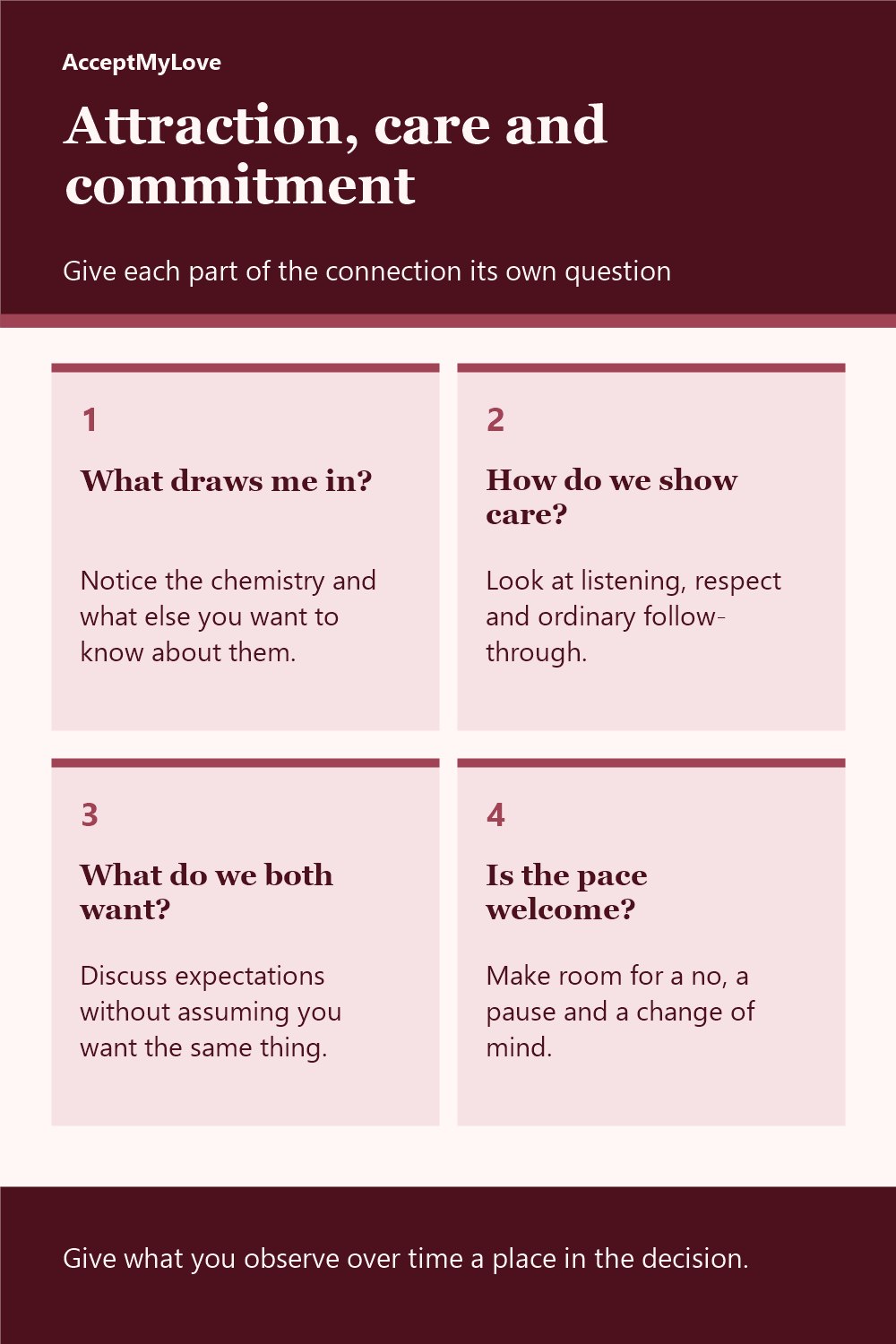
Read the infographic in text
Attraction, care and commitment
- What draws me in? Notice the chemistry and what else you want to know about them.
- How do we show care? Look at listening, respect and ordinary follow-through.
- What do we both want? Discuss expectations without assuming you want the same thing.
- Is the pace welcome? Make room for a no, a pause and a change of mind.
Give what you observe over time a place in the decision.