

Before dating your boss, look at who controls your pay, shifts, promotion and daily working conditions. Mutual attraction does not remove that power difference. A useful first step is to understand the workplace rules and whether either person could freely say no.
You do not need to feel ashamed of attraction or make an immediate decision about it. Separate what you feel from what would make a relationship workable. The manager carries responsibility for handling their authority appropriately; the more junior person should not have to solve every conflict or absorb every career cost.

Look at the power difference before the romance
A boss may influence your assignments, references, leave or access to opportunities even when you are off duty. Ask yourself whether you could decline a date, disagree, slow things down or end the relationship without worrying about work consequences. A private promise to keep work separate cannot answer every practical concern.
The CIPD overview of workplace relationships identifies conflicts of interest, favouritism and unfair treatment as potential concerns, with greater risks when a manager and a more junior colleague are involved. Consider the actual reporting structure rather than relying only on good intentions.
Give yourself time to understand the attraction
Working closely can create admiration, familiarity and excitement. Those feelings do not tell you everything about how someone behaves in a personal relationship. You may know how they lead a meeting without knowing how they handle disappointment, a boundary or a disagreement outside work.
Consider what you want apart from their approval. Would you still want to know this person if they could not influence your career? Do you feel able to choose, or are you responding to repeated invitations you are afraid to refuse? You can keep the relationship professional while you think.
Read the policy and ask about reporting arrangements
Check your employer’s current rules on personal relationships, disclosure, conflicts of interest and reporting lines. Policies differ. Find out who can explain the process without involving the manager you are considering dating, and ask what information would be recorded, shared and acted on.
If a relationship is already developing, discuss whether supervision and decisions about pay, performance or promotion can be transferred through an approved process. A reporting-line change needs to work in practice, including indirect influence. Do not assume that transferring you, reducing your hours or asking you to resign is the only acceptable solution. You can seek independent advice before agreeing.
Separate personal privacy from required disclosure
You may reasonably want to keep personal details away from office gossip. That is different from concealing a relationship from a person or process that must manage a conflict under the workplace policy. Ask what disclosure is required and what can remain private; do not promise secrecy before you understand the consequences.
A manager asking you to hide concerns, delete messages, accept special treatment or keep a relationship secret indefinitely is a reason to pause. You do not have to prove their motives before deciding you are uncomfortable. Protect colleagues’ confidential information and avoid using work access to monitor anyone’s personal life.
Make practical agreements if you both choose to continue
Discuss how work decisions, social events, messages and disagreements will be handled. For example: “Personal disagreements need to stay out of performance reviews. Who will make those decisions, and how can either of us raise a concern?” Any agreement still needs to follow workplace policy and leave both people free to change their minds.
Think through an ending as carefully as a beginning. Who would supervise the work afterwards? Could each person maintain professional contact without unwanted personal messages? What would happen if a transfer were unavailable? These questions may lead you to wait until there is no supervisory relationship, or to decide against dating. Neither choice requires denying the attraction.
Seek support if pressure or retaliation becomes a concern
If invitations are unwanted, your work conditions seem tied to romantic or sexual attention, or you fear consequences for saying no, seek a reporting or advice route that does not depend on the person involved. Options may include another manager, HR, a union representative or an independent employment adviser. Ask about confidentiality and limits before sharing sensitive details.
In the United States, the EEOC explains sexual harassment and its connection to adverse employment decisions. Coverage and complaint deadlines depend on the situation; readers elsewhere should use their local employment or equality service. Keep an accurate record of relevant events when safe and lawful, without taking confidential workplace material you are not entitled to retain.
You deserve room to consider your feelings without being pressured to trade security or opportunity for a relationship. Before the next step, identify the policy, the reporting line and one independent source of support.
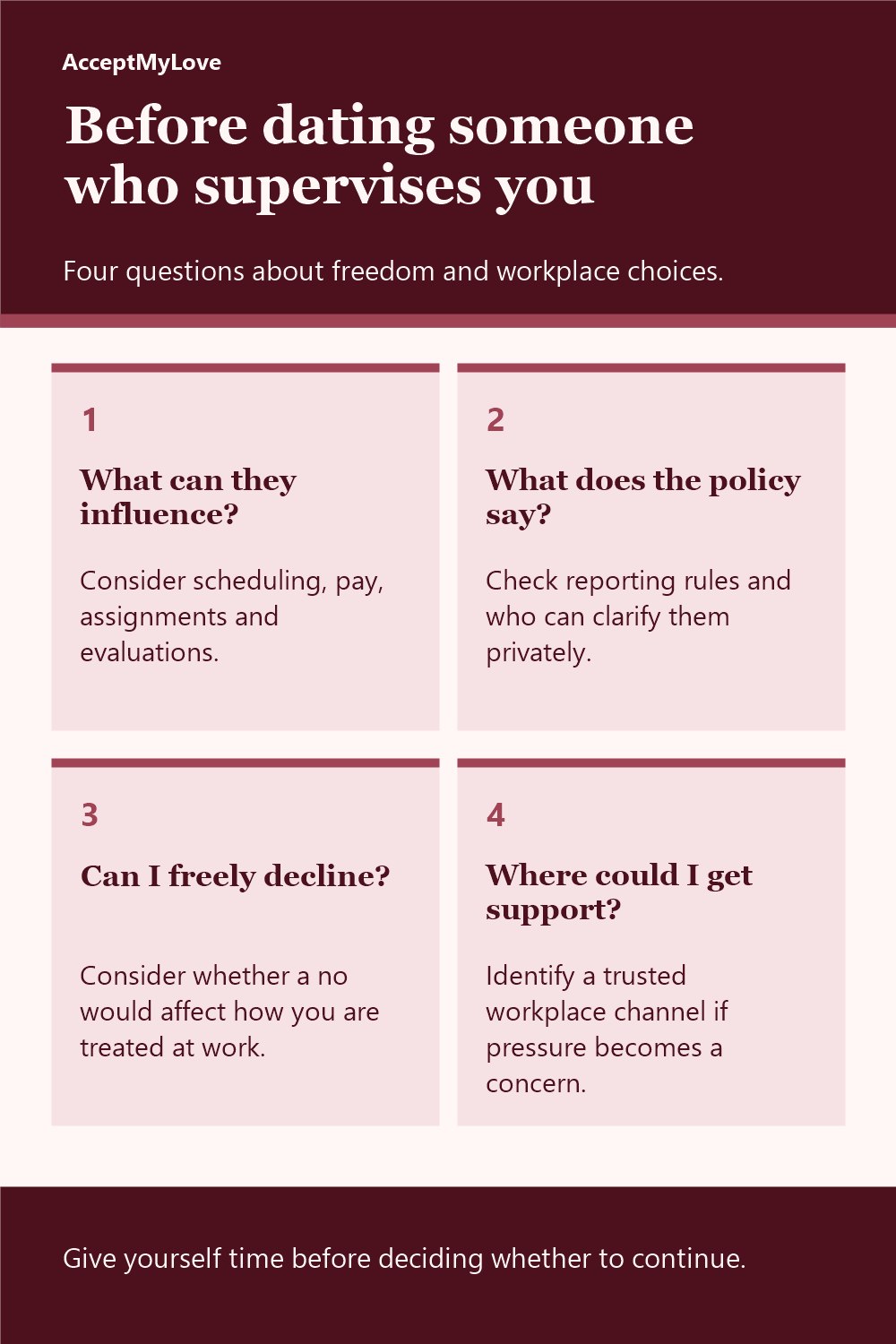
Read the infographic in text
Before dating someone who supervises you Four questions about freedom and workplace choices.
- What can they influence? Consider scheduling, pay, assignments and evaluations.
- What does the policy say? Check reporting rules and who can clarify them privately.
- Can I freely decline? Consider whether a no would affect how you are treated at work.
- Where could I get support? Identify a trusted workplace channel if pressure becomes a concern.
Give yourself time before deciding whether to continue.