

Having romantic feelings for your best friend can leave you hopeful, anxious and uncertain about what to do. You can take those feelings seriously without assuming the friendship must become a relationship. Your friend has their own wishes, and both of you deserve a choice.
Closeness, shared history and affection may make the question feel especially important. They do not prove mutual attraction or guarantee that dating would work. You can reflect before speaking, make one honest invitation if appropriate, and decide what boundaries you need afterwards.
Ask what you want from this particular friendship
Are you interested in dating your friend as they are, or are you mainly longing for reassurance, exclusivity or relief from uncertainty? You do not need a perfect label for every feeling. It helps to notice what you imagine changing: more affection, a romantic commitment, sexual contact or a different place in each other’s lives.
Consider what you already know about their wishes and availability. A friend who has said they do not want romance has given you useful information. Frequent messages, kindness or time together do not cancel that answer. Friendship can be deeply loving without becoming romantic, whatever either person’s gender or sexual orientation.
Choose whether now is a suitable time to talk
You can take time to think, write privately or talk with someone outside the friendship who will respect both people’s privacy. Avoid asking mutual friends to investigate, build a case or persuade your friend. Your aim is to understand your own choices, not to make a private feeling into a group project.
If your friend is in another relationship, has recently declined, or is relying on you during a crisis, consider whether an invitation would add pressure. You can set limits on your own availability without demanding romance in return. Waiting is useful when it gives you clarity; waiting indefinitely for someone to change can keep you stuck.
Offer a clear invitation with space for an honest answer
If you decide to speak, choose a private but comfortable setting where either person can leave. Keep it simple: “I value our friendship, and I’ve noticed I’d like to go on a date with you. Would you be interested? It’s okay if you don’t feel the same.” Adapt the words so they sound like you.
An invitation is easier to answer than a long account of everything you have sacrificed or imagined. Give them time if they ask for it, without requesting repeated reassurance. Do not surprise them with physical contact to test the answer. A direct question leaves room for a direct choice.
Respect a no and be clear about an uncertain answer
If they do not want to date, accept the answer without bargaining, listing your good qualities or comparing yourself with their partners. Disappointment is understandable, and you can process it with someone else. Your friend does not owe you romance because you have been supportive or patient.
If they are unsure, ask what that means for present contact rather than treating uncertainty as a secret yes. You can say: “I won’t keep raising it. For now I’ll understand that we’re friends.” You may also need a break. Love is respect’s guidance on boundaries emphasises being able to express needs and limits without fear of the other person’s response.
If the interest is mutual, talk about what dating means
Knowing each other as friends gives you a shared history; it does not mean every romantic expectation is already agreed. Discuss whether this is one exploratory date or a decision to become partners. Ask about physical affection, exclusivity, communication and what you want to tell mutual friends.
Keep room for either person to discover that dating does not feel right. You do not have to rush because you have known each other for years. Paying attention to how you handle new boundaries can be more useful than assuming friendship has already settled every question of compatibility.
Decide what friendship and space can look like afterwards
Some friendships continue comfortably after this conversation; others change or need a pause. You cannot promise the outcome for both people. If close contact keeps renewing your hope or hurting you, explain a practical limit: “I need some time without one-to-one evenings while I work through this.” Avoid presenting distance as a punishment or a tactic to make them chase you.
Keep investing in other people, interests and routines. If faith matters to you, prayer or reflection with a trusted person may help you consider your values. It should leave room for your friend’s answer and your own wellbeing, rather than requiring endless self-sacrifice.
You can care deeply about a friend and still choose a different level of contact. One honest conversation, respect for the response and a boundary you can maintain are worthwhile steps, even when romance is not the outcome.
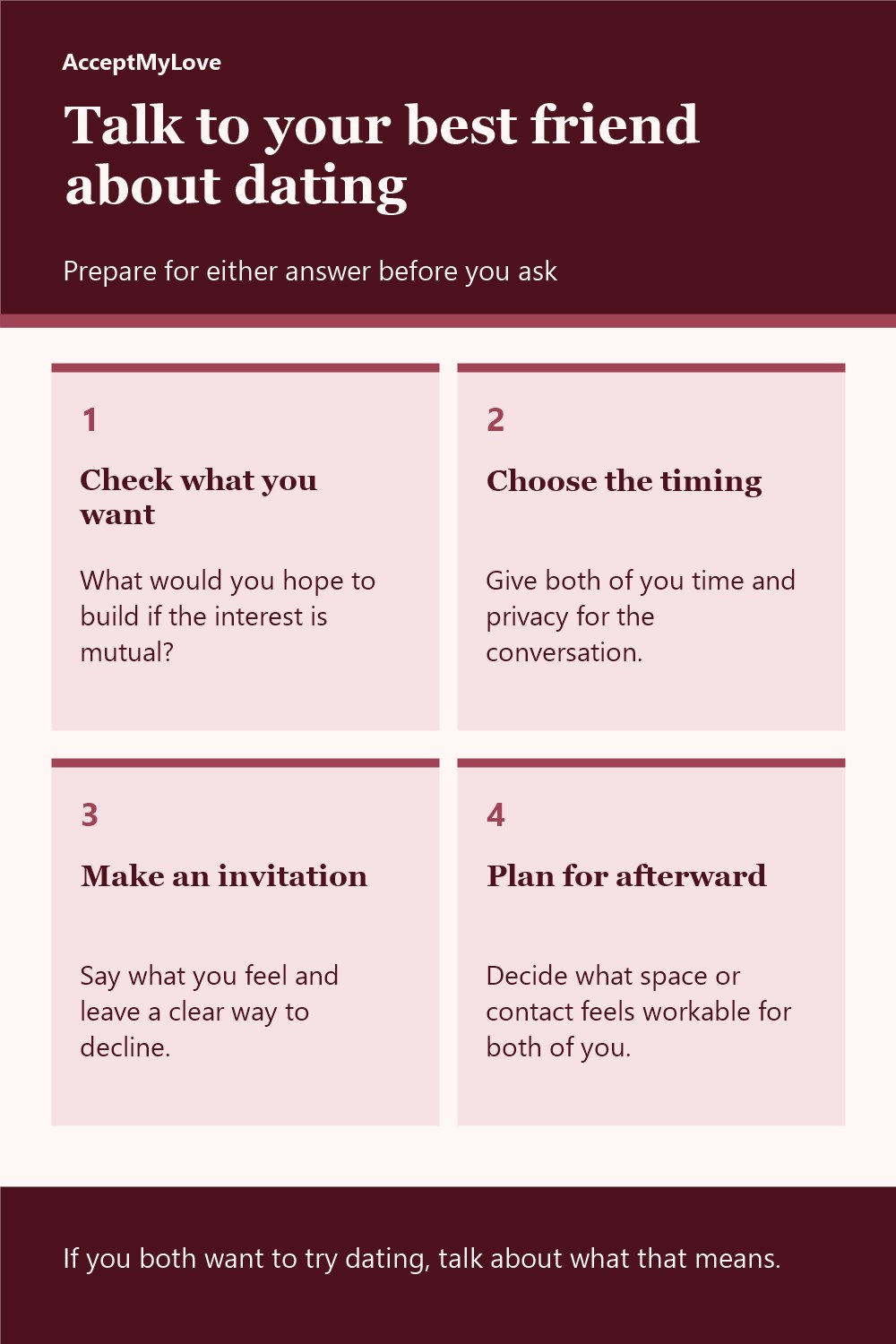
Read the infographic in text
Talk to your best friend about dating
- Check what you want What would you hope to build if the interest is mutual?
- Choose the timing Give both of you time and privacy for the conversation.
- Make an invitation Say what you feel and leave a clear way to decline.
- Plan for afterward Decide what space or contact feels workable for both of you.
If you both want to try dating, talk about what that means.