

Opening up to love does not require constant optimism or an instant return to dating. It can begin with one manageable conversation, a clearer sense of what you want, or permission to move at your own pace. You can be interested in connection and still have boundaries.
If “soulmate” is meaningful to you, it may describe the depth of partnership you hope for. Some people also use “energy” to describe how open, tired or comfortable they feel. Those ideas can support reflection, but they cannot tell you what another person will choose or promise when a relationship will arrive.

Make room for the feelings you already have
After rejection or a breakup, you may feel hopeful one day and reluctant the next. You do not need to erase disappointment before speaking to someone new, or force a date to prove you have moved on. Notice what kind of contact feels manageable now: time with friends, a group activity, a short conversation or a pause.
Ask: “Am I curious about meeting this person, or am I trying to stop feeling unwanted?” Either answer can tell you something useful. If you choose a break, give it a purpose that supports you, such as restoring a routine or spending time with people whose company feels comfortable.
Describe the partnership you want in everyday terms
Rather than trying to identify a destined person from a sign, describe what a satisfying relationship would involve. You might want honest communication, compatible plans about children, affection without pressure, shared faith or enough independence for your interests. Separate what matters deeply from preferences you can explore more flexibly.
Try completing three sentences: “I want us to be able to talk about…”, “I need to feel free to say…” and “Our daily lives would need room for…”. A useful description helps you ask questions and notice behaviour. It does not turn another person into a checklist or make every difference a warning.
Choose a small step you can comfortably repeat
Pick something within your control. Join an activity you would enjoy even without a date, ask a friend about an upcoming event, or reply to a message that genuinely interests you. If you use a dating app, decide how much time you want to spend there and which personal details you prefer to keep private.
Make the step small enough that you can stop or adjust it. A short daytime meeting may suit you better than a full evening; a conversation may be enough for today. You are creating opportunities to know people, not setting a deadline by which someone must choose you.
Be open while keeping your limits
Openness can mean saying what you enjoy, asking a sincere question or admitting you would like to meet again. It does not mean accepting every invitation, revealing your history immediately or overriding discomfort. You can say: “I’d like to get to know you, and I prefer to take physical intimacy slowly.”
Notice how the other person responds. Respect for a small limit gives you information about the interaction; pressure to prove your trust gives you information too. You can leave or decline without diagnosing them or defending every feeling. If you are unsure, slow down and talk with someone you trust.
Look for mutual interest through actions and conversation
Intuition can prompt a question, but it cannot establish another person’s intentions. Look at whether you both make plans, follow through, ask questions and respect each other’s time. If the pattern is unclear, a direct conversation usually offers more usable information than repeated attempts to interpret signs.
A spiritual practice such as prayer, journaling or meditation may help you reflect on what matters. Keep the other person’s words and choices central. A meaningful coincidence does not create an obligation to stay, and a disappointing date does not show that your energy or worth is wrong.
Keep a life that supports you while you date
Leave time for friendships, rest, interests and practical responsibilities. The NHS guidance on healthy relationships includes open conversations, personal boundaries and time for your own interests. These are useful things to make room for whether you are dating, partnered or single.
After an interaction, ask what you learned instead of judging yourself on whether it became a relationship. Did you enjoy the conversation? Could you be yourself? Would you choose to meet again? You can change your approach, take a break or seek support if dating is becoming draining.
Choose one next step that fits your present life. Opening up can be gradual, and it can include saying no. A good connection needs two willing people and care over time; you do not have to make it happen through perfect thoughts or constant effort.
Read the infographic in text
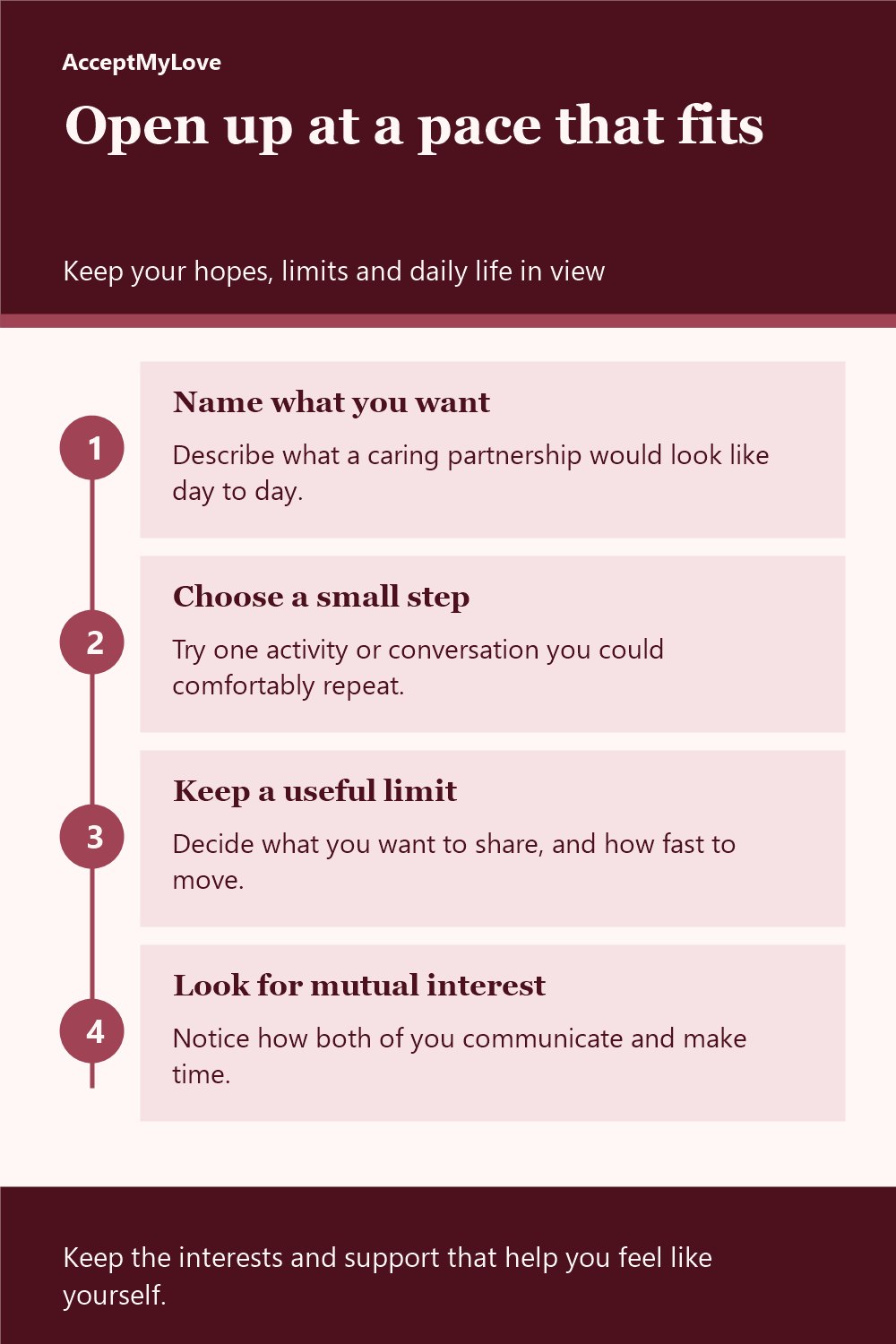
Open up at a pace that fits
- Name what you want Describe what a caring partnership would look like day to day.
- Choose a small step Try one activity or conversation you could comfortably repeat.
- Keep a useful limit Decide what you want to share, and how fast to move.
- Look for mutual interest Notice how both of you communicate and make time.
Keep the interests and support that help you feel like yourself.