

You can tell a man you like him, ask him out or send the first message. None of those choices makes you desperate. The point of stepping back from “chasing” is to stop carrying a connection that the other person is not choosing with you.
Interest does not need to follow a rule about who pursues whom. What matters is whether each person can choose freely, express what they want and contribute to contact. A connection can feel unequal without either person being a villain; you can still decide that it does not work for you.

Make an invitation that leaves room for an answer
Be clear enough that the other person can understand the invitation: “I’ve enjoyed talking with you. Would you like to get coffee on Saturday?” A specific, low-pressure question is usually more informative than hints, tests or repeated attempts to provoke jealousy.
Accept a no, including “I’m not interested in dating.” If the answer is unclear, you can ask once for clarity when appropriate. You do not need to keep contacting someone who does not answer, and you should not bypass a block or ask friends to persuade them. Their choice deserves respect, just as yours does.
Look for participation rather than a perfect message count
Mutual interest does not require identical texting habits or an exact split of invitations. Notice whether both of you help make plans, show curiosity and follow through. Someone who cannot meet at one time might suggest another; someone who needs less messaging can discuss that preference with you.
One slow reply cannot tell you how a person feels. A continuing pattern of vague promises, unanswered invitations or contact only when they want a favour gives you more useful information. You can describe the pattern without diagnosing their character or deciding that they secretly enjoy being pursued.
Keep rejection separate from self-respect
Being interested in someone who does not feel the same can hurt. It does not mean that you embarrassed yourself by asking, that you lack value or that every future connection will go the same way. Their answer concerns this relationship, not your overall worth.
Try language that states the event without attacking yourself: “I wanted a date and they declined.” Give yourself room to feel disappointed. If checking their profile keeps reopening the hurt, mute it or take a break from looking. You do not need to display indifference to prove that you are coping.
Say what kind of connection you want
If you are already seeing each other, ask about the relationship directly: “I want to keep dating, but I’m finding that I arrange all our time together. Do you want this too, and what can we both contribute?” Be ready to hear an answer that differs from the one you hope for.
You can set a boundary about your own participation: “I’m looking for regular time together. If that isn’t something you want, I’ll step back.” This is different from a threat, a secret deadline or withholding affection to force someone to pursue you. Love is respect explains why people should be able to express needs and limits without fear.
Leave room for the rest of your life
Keep plans with friends, interests, work and rest. Avoid repeatedly cancelling activities in case the other person becomes available. Being flexible sometimes is different from organising your whole week around a possible message.
Choose one practical limit that would help now: make plans without waiting for an answer, stop sending additional invitations or set aside an evening without checking their updates. You are making space for your own life; this is not a technique to make someone miss you.
Step back clearly when the pattern is not working
You can say: “I’ve enjoyed getting to know you, but I’m looking for more mutual effort. I’m going to leave it here.” You do not have to argue until the other person agrees with your interpretation. In a brief unanswered exchange, you may simply stop initiating.
If they later return, consider what has changed rather than assuming renewed contact proves commitment. The guide to deciding whether to give a ghoster another chance offers questions about explanations, expectations and your present wishes.
If you fear their response, prioritise your safety and get individual support rather than planning a confrontation. You do not owe a final in-person discussion to someone who has threatened or harassed you.
Choose relationships where both people have a voice
A person’s interest becomes clearer through what they say and how they participate over time. You cannot make them choose you by being more available, less available or more convincing. You can offer a connection and decide what you are willing to continue.
The aim is a relationship in which both people can initiate, decline, ask questions and be themselves. Making the first move can be part of that. So can recognising when the answer or the pattern asks you to move on.
Read the infographic in text
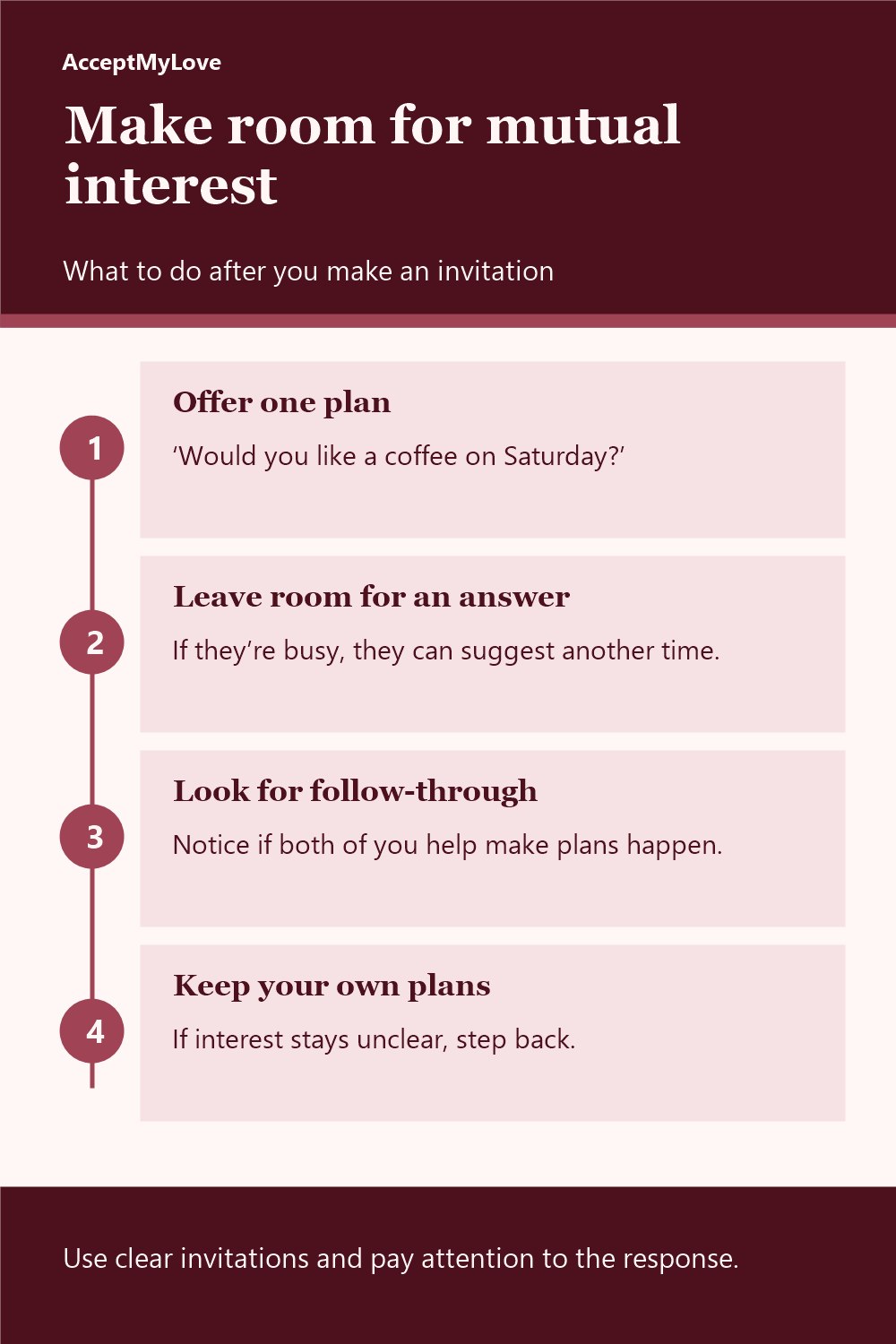
Make room for mutual interest What to do after you make an invitation
- Offer one plan ‘Would you like a coffee on Saturday?’
- Leave room for an answer If they’re busy, they can suggest another time.
- Look for follow-through Notice if both of you help make plans happen.
- Keep your own plans If interest stays unclear, step back.
Use clear invitations and pay attention to the response.