

Before agreeing to a trial separation, discuss what living apart would mean in daily life: where you would stay, how responsibilities would be handled and what each of you hopes to understand. The decision deserves practical planning as well as space for feelings.
Some couples consider separation while deciding whether to continue their marriage. Others already want to leave and need to organise the next steps. Be clear about which conversation you are having. A plan can reduce ambiguity, but it cannot promise reconciliation or require either person to stay.

Clarify what you each mean by a trial separation
Ask what the proposed time apart is for. Is the aim to reduce repeated arguments, consider whether your needs can be met, work on particular behaviours or prepare for a permanent separation? Each person may have a different understanding of the same phrase.
Try: “What would you want to learn during this time, and what decisions would still be open?” Agree on a time to review the arrangement rather than assuming there is one ideal length. A review date is a chance to assess what comes next; it is not a deadline by which someone must feel ready to reunite.
Consider safety before joint planning
If there are threats, violence, coercion or fear about your partner’s response, get individual advice from a domestic-abuse service before discussing plans together. You do not have to announce where you will stay or negotiate face to face when that could put you at risk.
The National Domestic Violence Hotline advises against joint counselling with an abusive partner. Information shared in a session may be used against the person experiencing abuse. An individual advocate can help you explore options and plan around your circumstances.
Get advice before changing housing or shared arrangements
Living apart can raise questions about your home, payments, property, benefits and children. The consequences depend on where you live and your situation. Obtain independent local family-law advice before moving out, changing shared financial arrangements or signing an agreement.
List questions for that adviser and gather information you can lawfully access. Do not assume an informal plan cancels existing responsibilities or court orders. If you cannot afford advice, look for local legal-aid or community family-law services and check their eligibility rules.
Write down practical agreements you can both understand
Where joint discussion is safe and possible, make the plan specific enough to follow. Useful topics include:
- Where each person will live and arrangements for access to the home.
- How essential bills and agreed expenses will be handled.
- Which communication channel to use, and what counts as urgent.
- Care for children, pets or other dependants.
- Privacy, visits and what you will tell other people.
- Whether dating others is part of the agreement.
- How to raise a problem and when to review the plan.
Separate arrangements you have agreed from questions still unresolved. Neither person should be surprised later by an assumption about exclusivity, spending or visits. If you cannot agree on an important point, seek suitable independent help rather than treating silence as consent.
Keep children’s needs separate from adult disagreements
If you have children, plan everyday care, school travel, health information, holidays and how they can contact each parent. Offer an age-appropriate explanation without blaming the other parent or asking children to carry messages. Avoid promises about getting back together when that has not been decided.
The Department of Justice Canada’s parenting-plan checklist offers questions about care and communication, including temporary arrangements. Its legal context is Canadian. Get advice relevant to your location and account for any safety concerns or existing orders before making a plan.
Choose specific changes to explore
Time apart alone does not show whether a relationship will work differently. Identify the behaviours or practical problems you want to address: repeated cancellations, an unequal workload, how disagreements escalate or incompatible expectations about the future.
Where it is appropriate and both people choose it, a qualified relationship counsellor may help structure those conversations. Individual support can also help you think through your own wishes. Therapy is not a way to assure a partner’s compliance, and no one should have to prove commitment by tolerating harmful treatment.
Review the arrangement without forcing an outcome
At the review, ask what has changed in daily behaviour, what still feels unresolved and whether both of you want the same next step. Missing each other can matter without answering questions about trust, responsibilities or safety. You may decide to reconnect gradually, revise the arrangement or end the relationship.
If you try living together again, discuss the agreements you will carry forward and how you will address problems when they recur. If one person wants to leave, the other person’s hope does not create an obligation to remain married. You can seek support for the practical and emotional decisions that follow.
Read the infographic in text
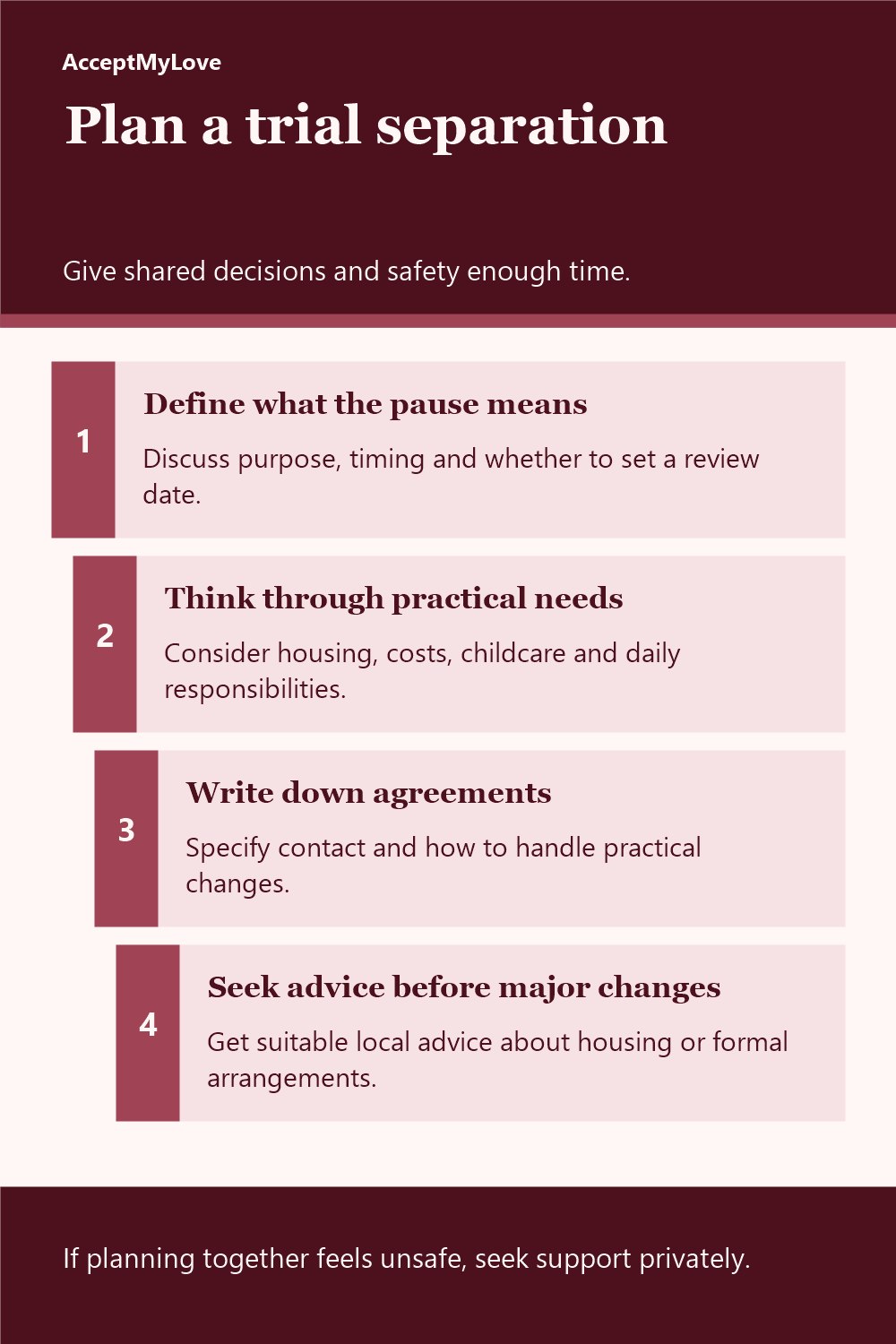
Plan a trial separation Give shared decisions and safety enough time.
- Define what the pause means Discuss purpose, timing and whether to set a review date.
- Think through practical needs Consider housing, costs, childcare and daily responsibilities.
- Write down agreements Specify contact and how to handle practical changes.
- Seek advice before major changes Get suitable local advice about housing or formal arrangements.
If planning together feels unsafe, seek support privately.