

A useful dating profile sounds like you, explains what you hope to find and gives someone a way to begin a conversation. You do not need to fit a rigid idea of what men want or present a flawless version of your life.
A quiet inbox does not prove that you have done something wrong. People have different preferences and circumstances, and a profile cannot control their choices. Focus on details you can make clearer, more accurate and more comfortable to share.
Say what kind of connection you want
Decide what you want someone to understand before they message you. You might be looking for a committed relationship, casual dates or a slower process of getting to know someone. Say so in ordinary language, allowing room for a real conversation.
You can describe important preferences without writing a test that every stranger must pass. For example: “I’m interested in a relationship and enjoy making time for each other. I’d like to meet someone who communicates directly.” Keep the details true to your own priorities.
Choose current photographs and check their backgrounds
Use your own recent photographs that show the person someone would meet. A clear picture of your face can help people recognise you. Choose images you feel comfortable making public, and get permission before including another identifiable person.
Look beyond whether a photograph is flattering. Check for a visible address, work badge, car registration, children’s school information or clues about a routine location. Privacy deserves attention even when the picture itself feels ordinary. RAINN’s safer-dating guidance recommends limiting personal information and being cautious about linking dating and social-media profiles.

Give your “About me” section a few specific details
Broad descriptions such as “fun,” “nice” or “easy-going” can mean many things. Add an example that shows what a pleasant day looks like for you. You can be concise while still giving someone something meaningful to respond to.
For example, if it is accurate for you: “I like finding a new walking route, cooking for friends and staying for the last song at a small live-music venue. I’m happy with a quiet Sunday too.” These are sample words to adapt, not a biography to borrow.
Read the result aloud. Does it sound like something you would say? Remove claims or activities included mainly because you think they will impress someone. A connection built around a performance can be hard to enjoy.
Turn interests into conversation openings
You do not have to hide your hobbies to leave something to discover later. Choose a few interests you would actually enjoy talking about, and add an inviting detail or question. “I enjoy films” could become “I’m always interested in a thoughtful mystery film. What have you watched recently?”
If there is something you want to try, say that it is new to you: “I’d like to learn a few basic dance steps.” You can also describe an accessible first meeting that fits your energy and budget. Avoid sharing the exact place and time you regularly spend alone.
State boundaries without turning the profile into a dispute
You are allowed to have clear limits about smoking, children, relationship goals or other matters important to you. Use straightforward wording instead of insults aimed at everyone who wants something different. Being respectful does not require making your boundaries vague.
You can keep the details of a past breakup private while being honest about your current situation. If you are separated, say what is relevant to someone deciding whether to date you. You do not owe a public account of an ex-partner’s behaviour, and another person’s identifying information should not become profile content.
Check clarity, privacy and whether the profile still feels current
Break up long blocks of text, correct confusing wording and check that your photographs and intentions still fit. Poetry, humour and an unusual writing style can be part of your personality; give the reader enough context to understand what you mean.
Before saving, ask: “Is this accurate? Is it comfortable to make public? Does it offer a useful starting point for a conversation?” If online dating is becoming draining, you can take a break or change how you use it. You do not have to keep adjusting yourself to win approval.
A profile introduces you. Mutual interest becomes clearer through respectful conversation and the choices both people make afterwards. Keep your own pace as you decide whom to meet.
Read the infographic in text
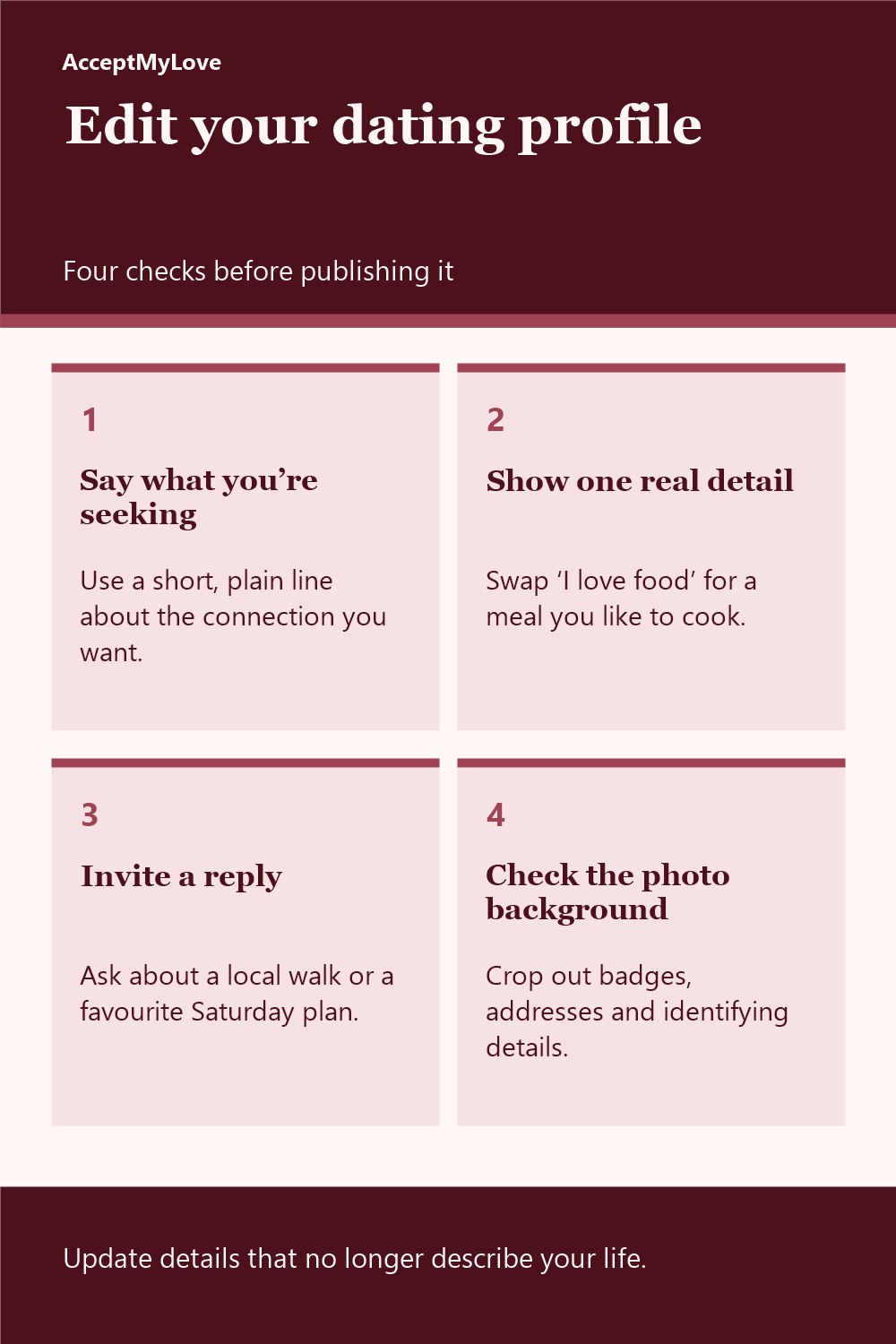
Edit your dating profile Four checks before publishing it
- Say what you’re seeking Use a short, plain line about the connection you want.
- Show one real detail Swap ‘I love food’ for a meal you like to cook.
- Invite a reply Ask about a local walk or a favourite Saturday plan.
- Check the photo background Crop out badges, addresses and identifying details.
Update details that no longer describe your life.