

When you want a clearer commitment and the person you are dating does not agree, affection can make the uncertainty harder. You may wonder whether to wait, ask again or leave. Start by identifying the relationship you want and what he is actually offering now.
This article speaks to someone dating a man, but these questions can apply to any partner. A difference about commitment does not prove that one person is unlovable or that the other has a hidden emotional problem. It is a difference you need usable information about.
On this page
- Define the commitment you mean
- Ask about the past without assuming the reason
- Separate practical barriers from the relationship decision
- Take the current answer seriously
- Include your own needs and limits
- Have a clear conversation
- Choose a next step you can actually take
- Review agreements through everyday actions

Define the commitment you mean
“Commitment” might mean agreeing to exclusivity, using a relationship label, planning a shared home or deciding about marriage. Those are separate questions. Someone may want an ongoing relationship without wanting marriage, or want marriage eventually without agreeing to the relationship you want now.
Name the specific agreement that matters to you. For example: “I want to know whether we are choosing an exclusive relationship.” Neither marriage nor exclusivity is a universal requirement; the useful question is whether both people freely want the same arrangement.
Ask about the past without assuming the reason
A previous divorce or a difficult family experience may matter to your partner, but it cannot explain his wishes on its own. Avoid deciding that he is frightened, needs to be healed or secretly loves you more than he can say.
You can invite an explanation without requiring a detailed personal history: “Is there something about this kind of commitment you do not want?” Listen to what he chooses to share. You are not responsible for resolving his past before you are allowed to make a decision about your present.
Separate practical barriers from the relationship decision
Money, housing, work or caring responsibilities can affect plans. If he says an expense prevents marriage or moving in, ask which part is difficult and whether he wants the same eventual step. An expensive wedding, a legal marriage and a shared commitment are not interchangeable plans.
If your wishes align, discuss a realistic next action that both of you want. If they do not, finding a cheaper plan will not create agreement. Avoid taking on costs or responsibilities in the hope that doing more will secure a promise.
Take the current answer seriously
“I do not want this,” “I am unsure” and “I want this but cannot make that plan now” communicate different things. Ask for clarification if the words are unclear. None is an agreement to the commitment you are requesting until both people actually choose it.
Someone can offer affection without offering the future you want. You do not have to establish exactly how deeply he loves you before deciding whether the present relationship works for you. Repeatedly searching messages for a different answer can keep the actual choice out of view.
Include your own needs and limits
Ask what is most difficult about the uncertainty. Is it not knowing whether you are exclusive, putting a personal plan on hold or feeling unable to discuss the future? A specific concern is easier to address than trying to prove that the relationship is serious enough.
Decide what you are willing to continue. You might be comfortable dating while a question remains open, or you might need to stop. You may choose a time to review your own decision, but a deadline cannot make someone genuinely want the same commitment.
Keep some time and support outside this conversation. The NHS guidance on healthy relationships discusses boundaries, taking time for yourself and talking with someone you trust.
Have a clear conversation
Choose a workable time and describe the agreement you want without presenting a case for why he owes it to you. You could say: “I care about you and want a relationship where we are both planning to live together. Is that something you want too?”
Listen, then check that you have understood. Ask about one unclear point rather than arguing with every part of the answer. Strong feelings do not invalidate your needs. If either person becomes too upset to continue usefully, pause and agree whether and when to return to the discussion.
Notice whether you can ask a question or disagree without threats or pressure. If you feel unsafe raising the subject, seek individual support before arranging another conversation. You do not have to resolve the relationship face to face at any cost.
Choose a next step you can actually take
If you both want the same arrangement, agree what it means in everyday terms. If you want different relationships, you can end the dating relationship or change contact in a way that works for you. You are allowed to be disappointed and still respect his answer.
Leaving is not a technique for making him chase you. Nor does it guarantee that the hurt will disappear. Consider support and practical arrangements, especially if you share a home or responsibilities. Our guide to coping with unreturned feelings explores distance and daily care.
Review agreements through everyday actions
If you continue together, look at whether the agreed next action happens and whether both people remain willing. A new promise after a difficult conversation is a reason to clarify the plan, rather than proof that every concern is settled.
You can change your mind as you learn more. Time already spent together does not require an unlimited further wait, and wanting commitment does not make you demanding. These ideas for choosing single life or dating at your own pace may help you consider what you want next.
Read the infographic in text
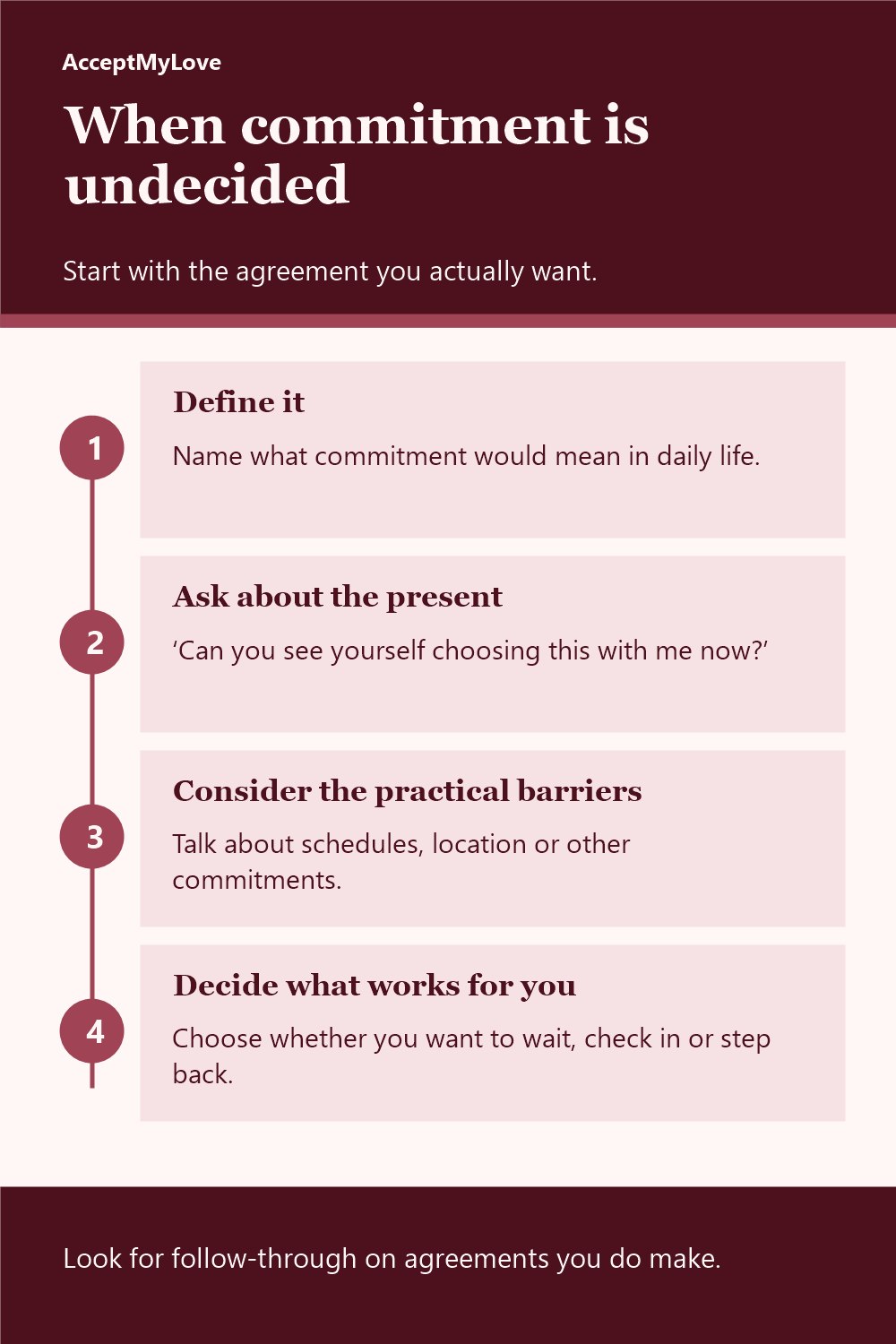
When commitment is undecided Start with the agreement you actually want.
- Define it Name what commitment would mean in daily life.
- Ask about the present ‘Can you see yourself choosing this with me now?’
- Consider the practical barriers Talk about schedules, location or other commitments.
- Decide what works for you Choose whether you want to wait, check in or step back.
Look for follow-through on agreements you do make.