

Gay dating can bring excitement, uncertainty and the hope of finding someone who understands you. There is no single way to date as a gay man: your background, comfort with being out, preferences and local community all shape the experience.
Start with what you want, then notice how you feel and how you treat each other. These six steps can help you explore a connection without rushing past your boundaries.
Decide what you are looking for right now
You might want a committed relationship, casual dating or simply a chance to meet people. It is fine if that changes, but be honest about where you are. You do not need to promise a future to make a present connection worthwhile.
Try a clear opening: “I’m interested in a relationship, but I want to get to know someone slowly.” Or: “I’m enjoying dating casually and don’t want to suggest I’m ready for exclusivity.” An honest difference is useful information; it does not require either person to negotiate away what matters.
Discuss expectations rather than assuming them. Monogamy, non-monogamy and exclusivity mean different things to different people. No relationship structure belongs to every gay man, and each requires freely agreed boundaries. If you are unsure where you stand, clarifying whether you are dating can help you start the conversation.
Meet people in ways that suit your life
Dating services are one option. Community events, hobby groups, volunteering and introductions through friends can also create opportunities to meet people. Choose settings you enjoy rather than treating every social activity as a search for a partner.
If you use an online profile, describe your interests and intentions accurately. Ask about something the other person has mentioned: a favourite walking route, a book or an activity you both enjoy. You can be curious without agreeing to every preference or performing a version of yourself you cannot sustain.
Before moving to another messaging service, decide what you are comfortable sharing. A promising conversation does not create an obligation to give out your surname, workplace, address or private photographs.

Protect privacy without losing clarity
Being out can mean different things in different parts of someone’s life. Ask what can be shared, including photographs, names and details about where someone lives or works. Never out someone or publish private messages without permission.
You might ask: “Would you be comfortable being introduced as my date if we run into someone I know?” or “Please check with me before posting a picture of us.” Agreeing beforehand is kinder than deciding for someone in the moment.
You can respect a person’s privacy and still decide whether the arrangement meets your needs. Pocketing in a Relationship: Privacy, Secrecy and Your Choices explores that distinction without treating public visibility as a test of love.
Make first meetings comfortable and manageable
- Choose a public place and a plan you can leave independently.
- Keep the first meeting simple, with a length and budget that feel manageable.
- If safe for you, tell someone you trust where you will be and when you expect to check in.
- Ask about comfort and consent; a date or an earlier yes does not oblige either of you to continue.
- Change the plan or leave if your boundaries are ignored.
A video call can help you decide whether to meet, but it cannot establish that someone is safe. Precautions may reduce some risks; responsibility for harmful behaviour belongs to the person causing it. Love is respect’s guidance on respecting boundaries offers useful questions about asking rather than assuming.
Let rejection be information, not a verdict
Not every promising conversation will lead to a date, and not every date will become a relationship. A mismatch does not establish that you are undesirable or behind everyone else.
If you do not want to continue, a brief message may be enough: “Thank you for meeting me. I don’t feel the connection I’m looking for, and I wish you well.” You do not owe further conversation when contact is hostile or threatening.
If someone declines, accept the answer rather than trying to earn another chance through repeated messages. Take breaks when dating becomes draining, and keep time for friendships and activities outside romance. Our guide to coping with unrequited love may help when feelings are not returned.
Look for mutual effort at a workable pace
A connection has room to develop when both people can ask questions, make plans, express preferences and say no. Notice whether interest becomes considerate action: suggesting another time after a cancellation, remembering an important boundary or checking what would make a plan comfortable.
After a date, ask yourself: Did I feel able to be honest? Was my pace respected? Do I want another meeting, or am I mainly worried about losing the opportunity? You can choose one more conversation without committing to a future.
You can also read 10 dating tips for LGBTQ+ readers for another perspective.
Read the infographic in text
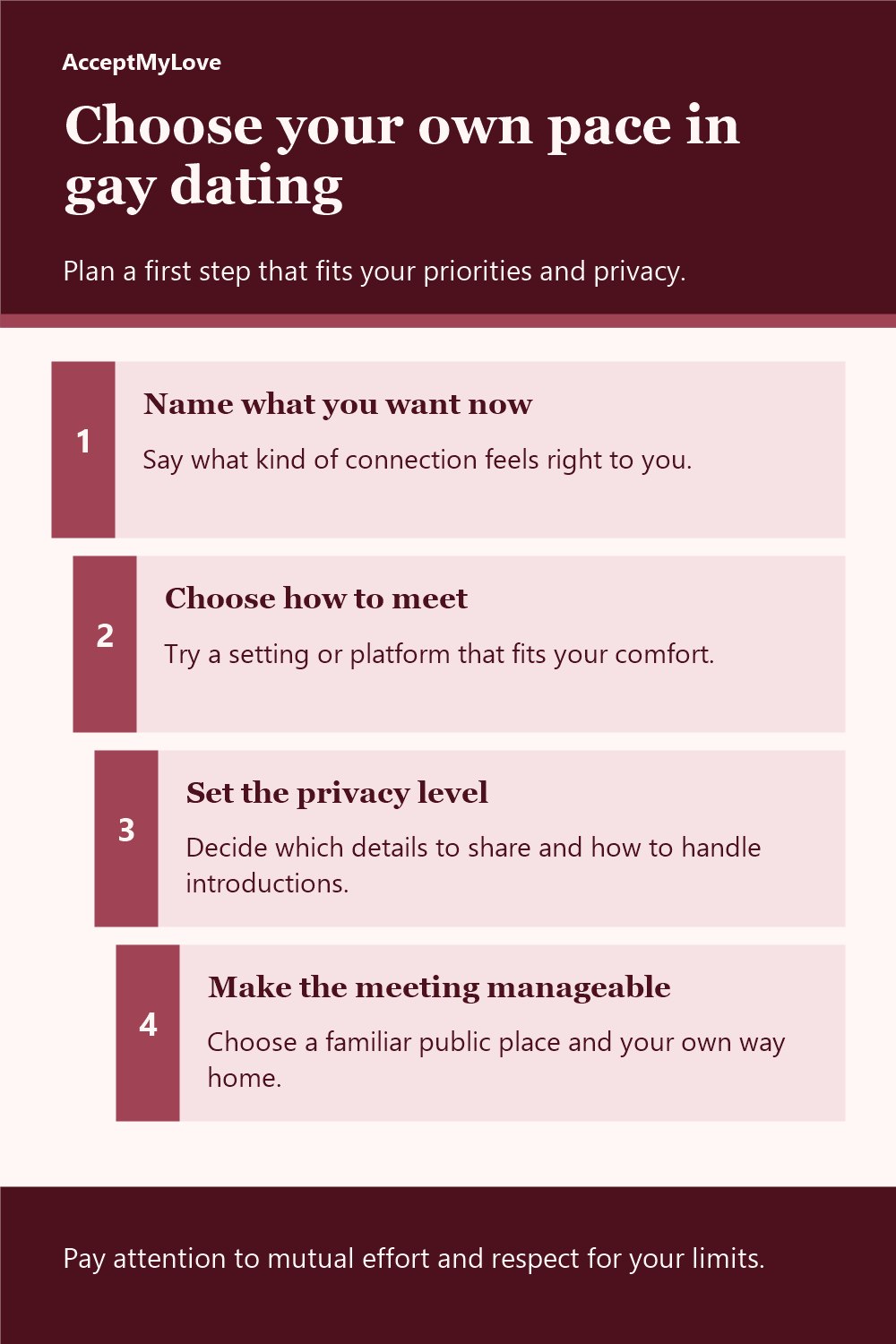
Choose your own pace in gay dating Plan a first step that fits your priorities and privacy.
- Name what you want now Say what kind of connection feels right to you.
- Choose how to meet Try a setting or platform that fits your comfort.
- Set the privacy level Decide which details to share and how to handle introductions.
- Make the meeting manageable Choose a familiar public place and your own way home.
Pay attention to mutual effort and respect for your limits.