

Accepting a partner means seeing the person who is here, including ordinary differences you can live with. Settling is a word people often use when they feel they are repeatedly setting aside something important to remain in the relationship.
The useful question is what the difference means in your actual life. Separate preferences, essential needs, harmful behavior and outside pressure before deciding what you want to do.
Look at the concern behind the label
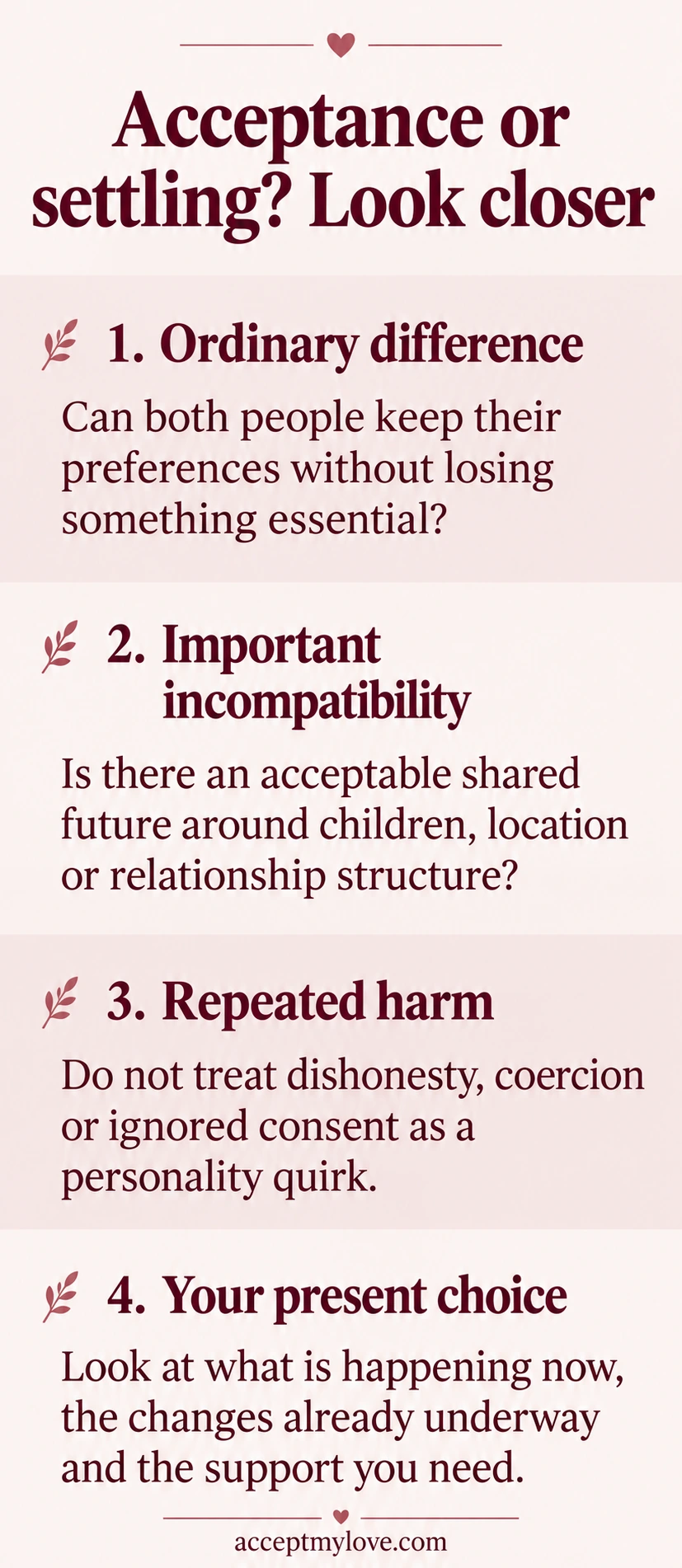
Read the guide as text
- Ordinary difference. Can both people keep their preferences without losing something essential?
- Important incompatibility. Is there an acceptable shared future around children, location or relationship structure?
- Repeated harm. Do not treat dishonesty, coercion or ignored consent as a personality quirk.
- Your present choice. Look at what is happening now, the changes already underway and the support you need.
What Does Settling Mean to You?
People use the word settling differently. One person might feel that it means someone who doesn’t meet their physical preferences, and others might feel that it is dealing with ongoing disrespect.
These are situations that have different points and need different conversations. A broad label can hide the issues that need to be talked about.
If you’re worried that you’re settling, ask yourself why and give specific examples. This could be not getting enough affection, having incompatible goals, or dishonesty. Acceptance should also be talked about. It doesn’t mean that you approve of promising to stay no matter how you are treated. You can understand someone and care about them but decide that the relationship doesn’t meet your own needs. Knowing reality is helpful if you stay together or choose to leave.
How do the differences affect your life?
Some differences can be enjoyed because they are easy to deal with. Having different hobbies gives everyone a chance to do their own things. Different preferences for what you eat can be dealt with easily.
Other differences can affect your overall wellbeing. These can include things like children, exclusivity, location, finances, religion, caregiving, or the amount of closeness each person wants.
Don’t try ranking your needs according to if other people consider them exciting. Wanting a certain kind of affection or a certain family plan can matter even if someone chooses differently.
If your partner doesn’t love camping but you do, and they like spending their weekends separately, that might be acceptance. If they want children and you don’t, though, this is a difference that needs a much bigger conversation.
Look At Your Relationship Now
Ask what you're choosing now instead of what you'd rather have if your partner became a different person. Hope can be an important thing when it's connected to effort and change. It's less helpful when the relationship depends completely on a future version of someone who's not agreed to become them.
Ask yourself, "If the main feature of this relationship stayed the same, would it feel good, or would it be painful?” This isn't a prediction that people don't change, but it's a way to stop looking at possible change as a fact.

Be honest about what's already going on in your life. For example, saying, "They're always going to appointments and following our agreement," gives different information than saying, "They say everything's going to be better once work slows down." Both need to be understood honestly.
Traits and behavior
A partner might be introverted, uninterested in traveling, or more comfortable with a small group of friends. You can decide if these differences fit your life without viewing them as something wrong with them.
Things like repeatedly lying, insulting, coercion, or not regarding consent are different from just personality differences. Don't talk about harmful behavior as something you should be more mature about.
Accepting someone’s individuality does not require accepting every behavior, and your acceptance cannot guarantee that they will change.
You have to be responsible for your own behavior. If you stay in a relationship while always criticizing your partner for being different from your ideas of the relationship, think about whether it is fair to either of you. Acceptance means honesty in both directions.
Make Sure Both People Are Compromising
Compromise is an important part of any relationship, but it shouldn't always mean that one person is giving up what they want to make the other person happy. Both partners should feel that their needs and feelings matter, even when they contribute to the relationship in different ways. For example, one person might pay more of the bills while the other takes care of more household responsibilities. What matters is that both people feel appreciated and that the arrangement works for them.
Think about who usually makes the changes when you and your partner disagree. Are you always the one changing your plans, giving up something you want, or putting your feelings aside? Does your partner make the same effort when something is important to you? Instead of focusing on one disagreement, think about how things usually work between you over time.
For an illustrative example, imagine Jessica and Ryan both enjoy spending the holidays with their families. Instead of arguing about whose family they should visit, they decide to alternate holidays so that both families get time with them. Neither person gets exactly what they want every year, but they're both willing to make adjustments because they understand that family is important to each other. But if Jessica always had to cancel her family plans because Ryan expected them to spend every holiday with his family, that wouldn't be a fair compromise.
You don't have to keep track of every little thing your partner does or make sure that everything is divided perfectly. Relationships aren't always going to be equal in every situation. However, there should be enough give and take that neither person feels like their needs are constantly being ignored. If something doesn't feel fair, talk about the actual responsibilities and decisions that are causing problems instead of arguing about who does more for the relationship.
Be Honest About Your Feelings and Attraction
Just because someone is a good person doesn't automatically mean they're the right romantic partner for you. Your partner might be kind, dependable, and someone your family and friends really like, but that doesn't mean you have to feel romantically attracted to them. Being treated well is important, but you shouldn't feel that you owe someone romantic feelings or physical affection simply because they've been good to you.
It's also normal for attraction to change throughout a relationship. Sometimes you might feel especially close to your partner, while other times things might feel a little different because of stress, responsibilities, or changes in your everyday life. Going through a period where the excitement isn't as strong doesn't automatically mean that the relationship is wrong. Think about whether you still feel connected to your partner and whether you both want to work on bringing back some of that closeness.
You should never feel that you have to force yourself to be physically affectionate or intimate just to prove that you're being a good partner. Both people should feel comfortable with physical closeness, and affection should come from a genuine desire to share that connection. If something doesn't feel right, it's okay to talk about your feelings and set boundaries instead of ignoring your own comfort.
One question you might want to ask yourself is if you really want to build a future with this person. Think about the emotional connection, physical attraction, friendship, shared values, and whether your lives fit together in ways that matter to you. Not every relationship will have the same level of excitement or affection, and there isn't one perfect way that love is supposed to feel. What's important is understanding what you need in a relationship and being honest about whether you and your partner can build something that makes you both happy.
Calmness Doesn’t Mean Secure or Distant
A relationship that feels calm might feel secure and comfortable, but it can also feel distant or absent. The word "calm" alone doesn't tell you which it is. Ask if you're curious, affectionate, allowed to raise concerns, and interested in each other. Do you feel at ease because you can be yourself, or are you quiet because you aren't being heard?
On the other hand, having intense chemistry doesn't prove that the relationship is meaningful or that it's healthy. Strong feelings can work with harmful behavior and plans that are never followed through.
If you're in a relationship and you miss the drama of a previous relationship, but you like how openly you can talk about your plans with your current partner, that's something worth paying attention to. That does not mean the new relationship is perfect. Someone else might feel no desired connection. Both of you need to pay attention instead of following a rule that calmness is always right.
Is Fear Involved?
Being fearful of loneliness, finances, social judgment, age, or other things can influence your decisions. Name the pressures so that you can face them, and this doesn't make you weak. Ask yourself these questions:
"What do I want from this relationship?"
What things do I need in order to make a different choice?
The second one might mean housing, childcare, more income, or even some kind of support.
Don't put yourself down for being practical, even if your options are limited. Getting resources affects your choice, and you can start getting information without making a final choice.
If you're dealing with abusive coercion, get private support. A reflection exercise isn't a safety plan, and you don't have to talk to your partner or tell them your doubts before you get confidential help about your situation.
Look At Your Own Standards
Some doubts concern the relationship itself. Others arise from pressure to pick someone with a certain income, appearance, education, or social background.
Ask yourself if the standard helps your lived experiences or makes the relationship look acceptable to someone else.
You can desire financial stability or shared education without looking at people as a checklist of status markers. Talk about your practical needs. Maybe the concern is debt secrecy, different goals, or a lack of interest instead of just a job.
If you're in a relationship and you worry that your partner is less outgoing than your friends expect, but in regular life you feel understood and have enjoyed your partner's shared routines, then the question concerns outside approval more than whether you're compatible. Another couple might need different social lives because context really does matter.
Having Safe Conversations
Don't ask if you're settling for your partner but ask about the actual concern. You could say something like, "I'm looking for a relationship where I talk about plans openly, and you and I keep avoiding this conversation." Tell them what you need and ask them to understand your point of view. Listen to the answer they give you instead of trying to negotiate until it looks like what you're hoping for.
NHS guidance discusses communication, boundaries and the effect of relationships on wellbeing. It also recognises that leaving a relationship can be an appropriate choice.
Having a conversation can let you talk about the problem without having to solve it. You might learn that both people want change and what adjustments are possible, or that the difference stays the same. Each of these is useful when you choose the next step in your relationship.
Try Making Small Changes Before Making a Big Decision
If you're having problems in your relationship but both of you are willing to work on them, sometimes making one small change can help you figure out whether things can improve. Instead of trying to fix everything at once, pick something specific that you both agree needs attention. Give yourselves some time to see how the change works and then talk about whether it's actually making a difference.
Maybe you and your partner have been so busy that you rarely spend quality time together anymore. You could agree to set aside one evening each week to do something you both enjoy. If the problem involves household responsibilities, you might decide that one person will take over certain chores completely instead of just promising to help out more. The important thing is that both people understand what they're agreeing to and are willing to follow through.
But not every relationship problem can be solved by making small changes. If one person wants children and the other doesn't, or if you have completely different beliefs or expectations about the relationship, those differences might be more about compatibility. You shouldn't expect someone to change their sexual orientation, give up an important belief, or accept a type of relationship they don't want just to make things work.
After trying the change for a while, sit down together and talk about how things are going. Did both of you follow through with what you agreed to do? Did the change actually help? Do you both feel better about the relationship? Sometimes small changes can make a big difference, but they can't always fix problems that involve completely different needs or future goals.
Appreciating Someone Doesn't Mean You Have to Stay
Just because someone has been good to you doesn't mean you're required to stay in a relationship that no longer makes you happy. You can appreciate everything your partner has done, the memories you've shared, and the effort they've put into the relationship without feeling that you owe them the rest of your life.
Sometimes a relationship can be meaningful and still not be right for you anymore. Your partner might be a wonderful person who has treated you well, but that doesn't automatically mean you're compatible in the ways that matter most. You don't have to pretend that the good times never happened or convince yourself that the relationship was a mistake just because you decide it's time to move on.
At the same time, it's important not to spend your relationship constantly wondering whether someone better might come along. No relationship is going to be perfect, and always comparing your partner to an imaginary person can keep you from appreciating what you already have. Instead, think about how you actually feel in your relationship, whether your needs are being met, and whether you're both willing to build a future together.
The biggest thing to ask yourself is whether you're staying because you genuinely want to be with your partner or because you feel guilty about leaving. Every relationship involves compromise, and there will always be times when things aren't easy. However, compromise shouldn't mean giving up the things that are most important to you or constantly convincing yourself that your feelings don't matter. You can care deeply about someone and still recognize that the relationship might not be the right one for your future.
Patterns and Seasons
If someone is going through a time of illness, grief, demanding work, or intensive caregiving, it can change how the relationship looks. Less energy or less enjoyable outings during these times doesn't mean that the connection no longer fits.
Ask if there's any kind of support, if both people's needs can be talked about, and if the situation is being looked at honestly. Going through a hard season can be easier to understand when you can say what's happening instead of just being told that your concerns need to disappear.
Compassion doesn't mean that you have unlimited understanding. You might need outside support, a new task, or support of your own. Consider the circumstances without using them either to dismiss the relationship or to erase your own needs.
Organise the concern behind acceptance or settling
Choose the kind of concern you are considering for questions that help separate preferences, incompatibility and harm.
This organiser does not give a stay-or-leave verdict. Safety and important needs cannot be reduced to a score.
Use the questions and examples in the article above; the draft builder needs JavaScript.
15 questions readers ask
1. Does accepting a partner mean accepting every behavior?
No. Respecting individuality does not require tolerating threats, dishonesty, coercion or ignored consent. Harmful behavior is different from an ordinary preference.
2. Does a relationship need to be effortless?
No. Effort can be part of a wanted relationship. Ask whether the work supports both people’s needs and choices, rather than treating difficulty alone as a verdict.
3. How do I distinguish a preference from an essential need?
Consider how the issue affects everyday life and the future you want. Different hobbies may be manageable, while incompatible wishes about children can be fundamental.
4. Can a kind person still be an unsuitable romantic partner?
Yes. Kindness matters, but it does not create an obligation to feel attraction or choose a shared future.
5. Does calmness prove the relationship is right?
No. Calm can feel comfortable or distant. Look at curiosity, connection, room to raise concerns and whether you actually want the relationship.
6. Does intense chemistry prove compatibility?
No. Strong attraction does not establish honesty, availability or compatible life plans. Those need their own information.
7. Should I stay because my partner might change?
Distinguish changes already being made from an imagined future. Ask whether the person has freely agreed to the change and whether you want what is available now.
8. How do I assess compromise?
Look at patterns over time. Do both people adjust and have a meaningful voice, or does one repeatedly give up what matters? Fairness need not mean identical contributions.
9. Is wanting attraction superficial?
You can consider the forms of connection that matter to you without reducing a person to appearance or status. You do not owe unwanted physical affection.
10. What if family and friends approve but I am unsure?
Their opinion is one perspective. Ask how you experience the relationship and whether your concern involves lived needs or pressure to satisfy someone else’s expectations.
11. Can fear of being alone affect my decision?
Yes. Name that pressure without shaming yourself. Practical information and support can widen your options without requiring an immediate final decision.
12. What if money or housing limits my choices?
Those are real constraints. Explore suitable practical and professional support. A reflection exercise cannot replace financial, housing, legal or safety planning.
13. Should I tell my partner I am settling?
A more useful discussion, where safe, names the specific concern and what you need. A broad label can obscure the actual issue or become an insult.
14. Can a small change clarify the situation?
Sometimes, if both people are willing and the relationship is safe. Choose a specific change and review it. Do not expect a small task to resolve incompatible essential goals.
15. Do I need to be completely certain before seeking support?
No. You can talk privately with a qualified professional or trusted person while uncertain. Support can help clarify the question without deciding for you.