

Showing someone you are interested can be as simple as enjoying a conversation and asking whether they would like a date. You do not need a special pose, a seductive gesture or a rule about where to put your arms. The aim is to communicate while leaving the other person comfortable saying yes or no.
Body language can add context, but it does not prove attraction or consent. Someone may be warm, distracted, shy, tired or simply friendly. Instead of trying to make them fall in love, focus on a respectful exchange in which both people can understand what is being offered.

Choose a welcome moment for conversation
Start where a brief conversation makes sense, such as a shared social activity. Ask about something you genuinely want to hear and offer a little about yourself. Notice whether they have time to talk rather than assuming you should keep their attention at any cost.
If someone is busy, stepping away or giving repeated brief replies without continuing, give them space. You do not need to decide whether the reason is disinterest, distraction or something else. If there is a workplace power difference, read Dating Your Boss: Power, Workplace Policies and Your Choices before treating the situation as ordinary flirting.
Show attention in a way that feels natural to both of you
Listen to what they say, ask a relevant question and give them room to finish. You might put your phone away if that helps you be present, or explain if you need it for communication or an urgent responsibility. Attention can be expressed in more than one way.
Eye contact, posture and gestures vary between people and situations. The National Autistic Society describes varied communication preferences, including discomfort with eye contact for some autistic people. Looking away or crossing arms does not automatically mean boredom or rejection, and you cannot identify a person’s intentions or diagnosis from one gesture.
Use words when a hint leaves too much to guess
A sincere compliment or a little playful conversation can be enjoyable when both people welcome it. Keep the comment appropriate to the setting, and notice whether they participate comfortably. A smile or a compliment back may still be friendliness. Neither person has to perform a particular version of flirtiness.
If you want to make your intention clearer, try: “I like spending time with you. Would you be interested in going on a date?” Naming the invitation can be kinder than escalating suggestive comments while hoping the other person understands. Give them time to answer without requiring reassurance.
Ask before touch and leave room for personal space
Do not use unexpected touch to test whether someone likes you. If the situation feels comfortable and you want to hold hands or kiss, ask in ordinary words and wait for a freely given response. You can say: “Would you like to hold hands?” If they hesitate, pull away or seem uncomfortable, stop and give them space.
Love is respect explains consent as an ongoing agreement. Agreeing to one kind of contact does not mean agreeing to another, and a previous yes does not remove the right to change their mind. A date, a gift or flirting creates no obligation to be physical.
Respond to the answer without negotiating it
If they want a date, suggest a practical time and place and check that it suits them. If they say no, you can acknowledge it simply: “Thanks for being clear.” You do not need to argue, request reasons or prove that they have misjudged you.
If plans remain vague, one practical follow-up can clarify whether there is a meeting to arrange. You can then leave the invitation with them rather than repeatedly messaging or treating silence as a challenge. A person does not need to explain their entire private life before you respect their lack of participation.
Keep room for your own comfort and choice
You are also allowed to lose interest, decline touch or decide that the pace is too fast. If you feel you must be unusually entertaining, sexually available or agreeable to keep someone interested, pause and consider what you would choose without that pressure.
Afterwards, ask what you learned: Did the conversation feel mutual? Could you express yourself? Did both people respect a boundary? Those questions are more useful than grading whether you made enough eye contact or used the right gestures. Clear interest creates an opportunity; a relationship still needs two willing people.
Read the infographic in text
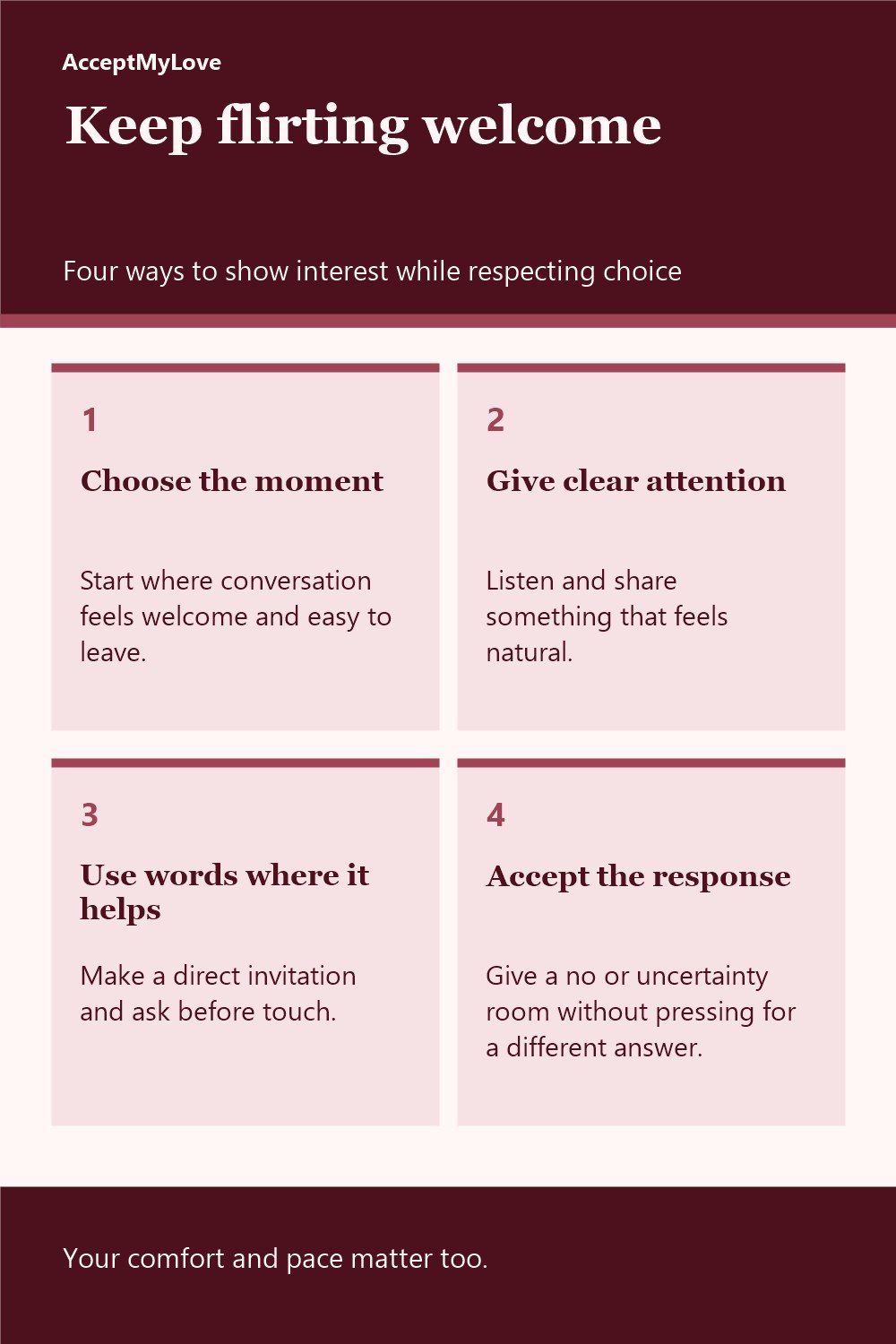
Keep flirting welcome
- Choose the moment Start where conversation feels welcome and easy to leave.
- Give clear attention Listen and share something that feels natural.
- Use words where it helps Make a direct invitation and ask before touch.
- Accept the response Give a no or uncertainty room without pressing for a different answer.
Your comfort and pace matter too.