

If you would like to meet men, start with places where you can enjoy being there and have a natural reason to talk. Shared activities can make an introduction easier, but being in the same place does not establish that someone is single or interested in dating.
Choose one or two options that fit your interests, access needs, budget and energy. Check the organiser’s current details, including booking, equipment, age restrictions and whether the event welcomes newcomers. You do not have to turn every outing into a search for a partner.
In any setting, notice whether conversation is welcome. A short answer, turning away or returning to another task is enough reason to let the interaction end. Someone can be friendly without wanting a date.
Sports and recreation you enjoy
A local match, a recreational league or a social walking group may give you something you already want to discuss. Go because the activity interests you, whether you are playing, watching or helping with an organised event.
Try a question about the shared setting: “Have you been to many games here?” Give the person room to answer and see whether they ask something back. Avoid interrupting active play or treating a friendly explanation as romantic interest.
If sports do not appeal to you, choose another activity. A connection does not require pretending to have someone else’s interests.
Bowling and social games
Bowling, a board-game evening or another organised social game can create pauses for conversation. Going with friends may make the outing enjoyable even when you do not meet anyone you want to date.
Look for events that welcome mixed groups or individual newcomers. Ask the venue how teams are formed rather than assuming you can join a private game.
“Is this your usual game night?” is a simple opening. You can accept help if you want it, or say, “Thanks, I’m happy to work it out.” Advice does not create an obligation to keep talking.
Food, drink and local social events
A café event, a community meal, a quiz or a brewery’s organised social evening may suit you. Check what the event actually involves and whether it offers a comfortable option if you do not drink alcohol.
Start with something you both experienced: “What did you think of that quiz round?” Leave space for other people at the table and let the exchange develop at its own pace.
Someone serving customers may need to be friendly as part of their work. Keep that situation separate from an invitation to someone attending the event with the same freedom to participate.
Classes and hobby groups
Language classes, art workshops, gardening groups, group golf lessons and other hobbies can bring people together around a shared interest. A recurring activity can let you become familiar with people without deciding immediately whether to date.
Ask about equipment, costs and the level of experience expected before booking. A group lesson may offer more opportunity to chat than interrupting someone practising alone.
Try, “Is this your first class here?” Talk during a break rather than while someone is concentrating or using equipment. Be friendly to the group as a whole.
Gatherings through friends
A friend’s gathering can offer introductions in a setting where you already know someone. You can say privately, “I’m open to meeting someone. If you know a person who might enjoy talking with me, would you be comfortable introducing us?”
Your friend may not know anyone suitable, and an introduction does not oblige either person to date. Avoid making the gathering about whether a particular person chooses you.
Ask before sharing contact details or photographs. If you enjoy the conversation, make your own invitation rather than asking friends to pressure someone for an answer.
Ordinary public moments
A queue, a public waiting area or a shared table may allow a brief conversation about the moment. Keep it easy for the other person to return to what they were doing or leave.
A situational comment can be enough; you do not need a rehearsed line. If the person keeps their headphones on, gives a brief answer or does not engage, let that be the end of it.
Avoid personal questions about where someone lives or works before they choose to share. A pleasant exchange can remain a pleasant exchange without turning into a request for a number.
Parks and organised walks
A public park, an organised walk or a dog-walking group may fit your interests. Respect personal space, check before approaching a dog and avoid interrupting someone exercising, supervising children or seeking time alone.
At a group walk, you might ask, “Have you done this route before?” Stay with the shared activity rather than following someone who moves away. Being alone or caring for children does not tell you someone’s relationship status.
If a conversation feels mutual, try a clear invitation: “I’ve enjoyed talking. Would you like to have coffee another day?” Accept a no without bargaining. Love is respect’s boundaries guide explains why asking and respecting the answer matter from the first invitation onwards.
If you both want to meet, choose a public setting and arrangements that let each of you leave independently. As dating develops, be honest about whether you want casual dating or something more committed. One enjoyable conversation does not settle that question for either of you.
Read the infographic in text
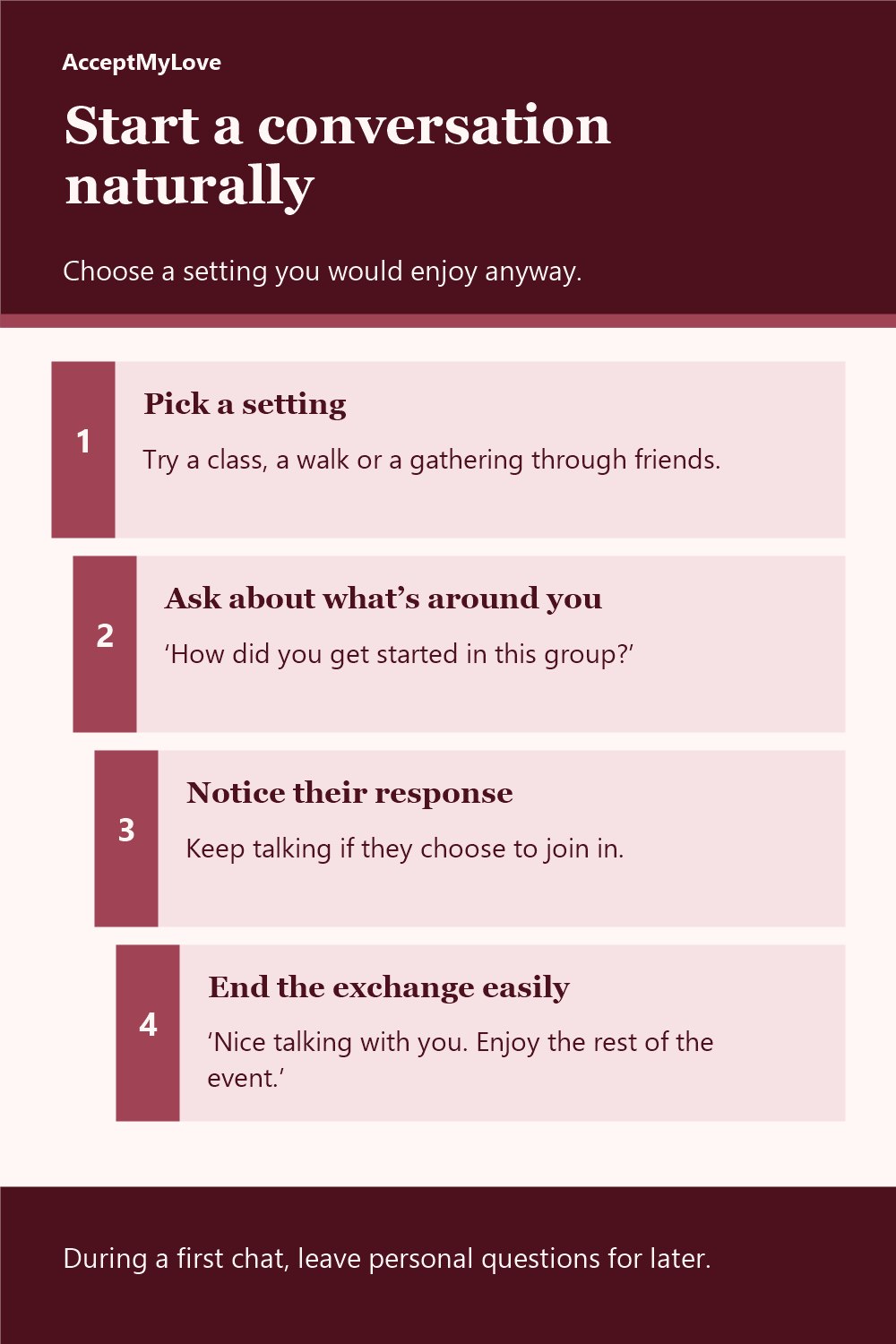
Start a conversation naturally Choose a setting you would enjoy anyway.
- Pick a setting Try a class, a walk or a gathering through friends.
- Ask about what’s around you ‘How did you get started in this group?’
- Notice their response Keep talking if they choose to join in.
- End the exchange easily ‘Nice talking with you. Enjoy the rest of the event.’
During a first chat, leave personal questions for later.